
By Saran Lewis
I must preface what I am about to say with this clear declaration. I do not accept the colour coded identity of ANY people. Colour coding is part and parcel of the system of White Supremacy under which human beings were separated into races which facilitated the creation of racism as a tool of control for profit.
Therefore when I speak of Black and White, I am not bowing to the system, I AM inviting us to awareness of the cages in which we have been bound so that we can SET OURSELVES FREE.
Acknowledging racism (or any other form of supremacy) does not weaken a community. Denying it does.
Real progress comes when leaders, neighbours, and institutions have the courage to face what is real: that we are equal in human worth and capacity, but not equally or ethically resourced or supported.
To move forward as a healthy community, we must not only refuse the myths of White Saviourism and Black Helplessness —we must also confront the shadows of superiority and inferiority, dominance and subordination, dismantling the structures that keep resources, relationships and opportunities inequitably balanced.
When we can finally do this we will be free, and only then can we begin to live the divine dream of building communities founded on wholeness, worthiness, authenticity, love, and belonging.
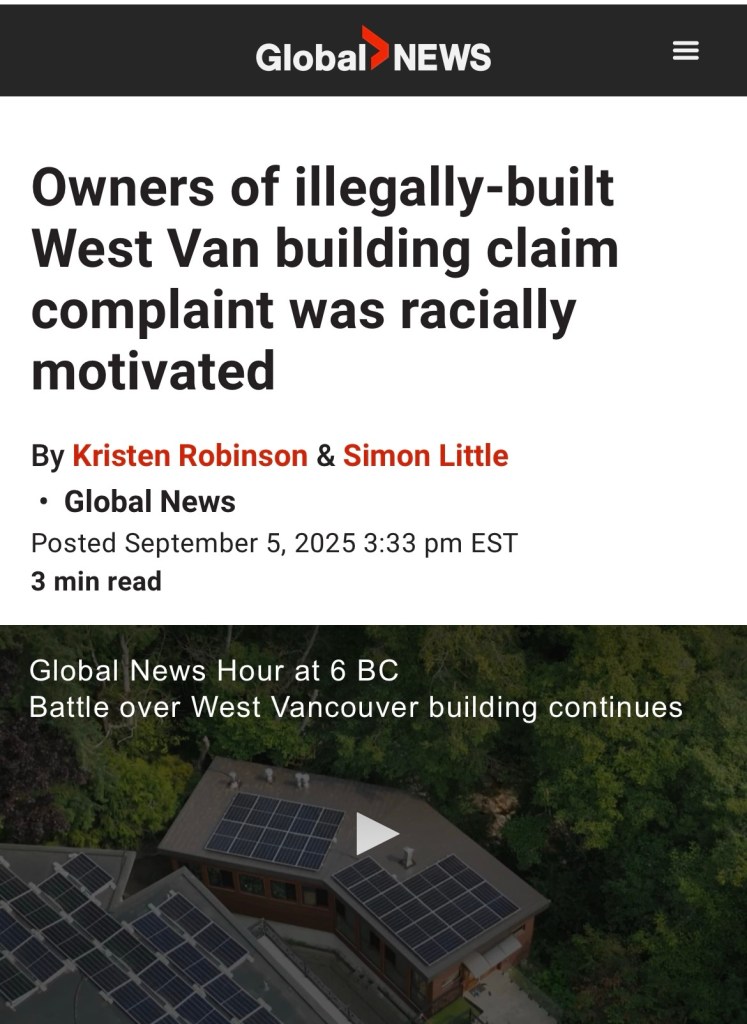
West Vancouver Mayor Mark Sager recently rejected the idea that a bylaw complaint against the owners of a multi-million-dollar home was racially motivated. “I would not buy that for a moment,” he told reporters.
But the homeowners had received an anonymous letter stating:
“Think of this as a lesson in what you can expect if you continue to live here. OR – go back to where you came from. You are not special, you are just like the rest of us, even though your God is greed.”
If that isn’t racism, what is?
The Cost of Denial
The issue is not only the letter. It is the way institutions and individuals reflexively minimize, deflect, or rationalize racism, as if acknowledging it were more dangerous than the harm racism itself inflicts. For those of us living in skin rich with melanin, this is nothing new. The exhaustion comes not just from racist incidents themselves but from the denial layered on top of them.
The Continuity of Harm
Being told to “go back to where you came from” carries the same weight as being called “nigger.” It is also the same as hearing a less-melanin-rich friend claim that African-American community leaders were always corrupt and incapable of managing funds—implying that White “saviour” managers were needed to control community resources.
The irony is sharp: Euro-American politicians and institutions have hardly been models of financial integrity. Yet the assumption of superiority persists.
The System Beneath It
These ideas are not random. They are the fruit of White Supremacy, which:
😔found African ingenuity and skill invaluable for centuries of forced labour to build White wealth.
😔dehumanized those same Afro-descended human beings and their descendants as inferior, despite their proven capacity, endurance, and creativity.
😔conditioned White society to expect compliance from Afro-descended people while labeling any demand for equality as arrogance punishable by death. Death of the body through lynching or torture, or death of relationship and connection, or death of reputation and character through gossip. No matter what form that death would take, it must involve the infliction of severe pain as punishment.
And so today, when people of colour clearly declare themselves capable equals—though not equally resourced and supported—and refuse the hero narrative, the myth of White Saviourism is shaken.
For some White neighbours and friends, this does not bring relief or joy but anxious anger. Afro-descended friends also experience anxious anger when one of their own rises to declare themselves capable equals. Internalized narratives of dominance and subordination run deep.
Equality disrupts the myth of White Saviourism, and the anxious anger is proof.
Expansion on “Anxious Anger as Proof”
That anxious anger is proof. Proof that the narrative of superiority and inferiority was never secure. Proof that the system has depended on compliance and deference to maintain its illusion.
Proof that equality is not simply a moral claim but a direct threat to the false comfort of dominance and subordination.
This speaks directly to Carter G. Woodson’s Mis-Education of the Negro. Woodson described how systems of oppression condition the oppressed to police themselves, to stay in the “place” designed for them. He wrote that if you control a person’s thinking, you don’t have to worry about their actions; they will seek the back door themselves. And if no back door exists, their conditioning will demand one be built.
Anxiety arises because the ground shifts: if communities of colour are not inferior and dependent, then White identity can no longer rest on the role of rescuer, manager, or hero, and Black survival is no longer secure and attached to deference.
Anxious anger arises because loss of control and lack of security feel like loss of identity, even when both are shadows, neither of which truly defined the healthy symbiotic reality through which humanity was intended to thrive.
The Shadows of Supremacy
Superiority
Anxious anger connected to dominance is not grounded in truth or logic. It is grounded in fear of losing unearned power. It is grounded in fear of losing superiority.
And superiority is an acquired ego shadow — a projection built over centuries to mask insecurity, justify exploitation, and maintain control. Shadows of the ego always claim more than they can hold. They are fragile, inflated identities that depend on comparison and domination rather than rootedness in love, dignity, or mutuality.
This shadow superiority convinces people that their worth rises only when others are pushed down. It distorts community into hierarchy, friendship into control, and leadership into possession. It separates the human spirit from the truth that every person is born whole, worthy, and beloved.
Spiritually, the ego shadow of superiority is a counterfeit covering. It promises safety through dominance but delivers only fear, anxiety, and anger whenever that dominance is questioned. Psychologically, it keeps individuals and societies locked in defensive postures, unable to welcome equality because equality threatens the illusion that gave them identity in the first place.
Inferiority
And there is also an inferiority shadow. This is the internalized belief, born of oppression, that one’s value must never rise at all — that one’s very existence, and even the foundation of the community, depends on staying in a subordinate place. This shadow persists regardless of education or economic success.
An Afro-descended professional can hold advanced credentials and yet feel compelled to defer, to shrink, to mute their voice in rooms where truth is needed. An entrepreneur can build wealth and still carry the gnawing belief that their achievements are fragile, conditional, or undeserved. The shadow whispers that visibility is dangerous, that confidence will be punished, and that dignity must always be negotiated against survival.
They may even teach about racism as a concept. But they cannot bring the full light of that truth to illuminate the shadows in their mixed community. The inferiority shadow tells them that naming racism too clearly will cost them belonging, credibility, or safety. It convinces them to intellectualize rather than embody, to make the truth palatable for the dominant group rather than liberating for their own.
And in this way, the inferiority shadow colludes with the superiority shadow.
The superiority shadow often hides in educated, progressive White spaces. It cloaks itself in allyship, theory, or “good intentions,” but still clings to the role of interpreter, manager, or validator. It whispers that people of colour need White mediation to make their words credible, that leadership must remain in familiar hands, that progress must be “guided” to keep everyone comfortable. It manifests in committees where diverse voices are welcomed at the table but only within boundaries set by White comfort. It shows up in policies written in the language of equity but enforced through the logic of control.
The superiority shadow convinces people that their worth is measured by how well they protect their elevated role. The inferiority shadow convinces people that their worth depends on not challenging that elevation. One insists on dominance; the other enforces submission. Together they uphold the false architecture of supremacy, even in communities that pride themselves on being enlightened.
And that is why equality so often provokes resistance. It unmasks the ego shadow and reveals how deeply society has been invested in stories of dependence and deficiency. Angry denial in the face of clear truth is not evidence that racism is “overstated.” It is evidence that racism is alive — defending itself through emotion when the miseducated logic is challenged.
Why Peer Support Matters
This is why community peer support groups are not optional—they are essential. They create spaces where people of colour can be heard, believed, and supported. Because each time a leader denies racism (or any other form of supremacy) even in the face of explicit racist words, the wound deepens.
Healing requires spaces of solidarity and truth.
A Healthier Way Forward
If West Vancouver—and any community—wants to be healthy, it must begin with honesty. Pretending that a racist letter is “not racism” only breeds mistrust and erodes the possibility of progress.
Acknowledging racism (or any other form of supremacy) does not weaken a community. Denying it does.
Real progress comes when leaders, neighbours, and institutions have the courage to face what is real: that we are equal in human worth and capacity, but not equally or ethically resourced or supported.
To move forward as a healthy community, we must not only refuse the myth of White Saviourism—we must also confront the shadows of superiority and inferiority, dominance and subordination dismantling the structures that keep resources and opportunities inequitably balanced.
When we can finally do this we will be free, and only then can we begin to live the divine dream of building communities founded on wholeness, worthiness, authenticity, love, and belonging.
 Nurturing Kindred