
The realizations I am sharing here came together cohesively after watching the documentary Bearing Witness: The Case of Robert Coley-Donohue, and after a meaningful conversation with a peer who has been working to optimize their mental health through the process of therapy with a clinician.
From the time I was very young, I carried a knowing in my heart and mind that all people need compassion, and that none of us is better than another.
We are all ordinary people with an extraordinary capacity for compassionate growth together.
Because so many of our systems are built on power-over and supremacy, what lived in me often appeared as stubbornness on the outside.
What I understand now is that it was not stubbornness.
It was a refusal to collapse into hierarchical conditioning — conditioning that claimed some people had the right to control others, or to hold dominant positions within relationships.
It was a consistent refusal to agree that worth could be ranked.
A consistent refusal to trade connection for control.
For most of my life, I did not have the language to express this knowing. I struggled to articulate a truth that nevertheless lived resolutely within me.
What I did have was a deep, steady sense that love does not organize itself by dominance — and a shadowy awareness that we were being conditioned into a counterintuitive framework of control. A framework that generates rebellion, dehumanization, and rupture as people struggle to live with freedom, dignity, and abundance.
So I resisted.
Not gracefully.
Not skillfully.
And always faithfully to that early knowing.
Most of the time I refused to take sides. I could almost always see the why—and I wrestled hard not to dive into hate where harm was being done. That inner battle sometimes looked like defiance, or dominance, or disruption.
And now I can see that what once looked like defiance was devotion — devotion to dignity, mine and everyone else’s, and devotion to freedom, abundance, and accountability.
As so often happens, this clarity arrived through relationship — the sum of lived experience finally filtering through the lens of the pure love of the higher power that sustains us all.
So I will offer a specific example and invite us to apply this lens to every relationship within our global framework. I’ll begin with the relationship between therapists and the people with whom they work.
Therapists are people with professional-level knowledge of current best-practice tools and approaches that support trauma processing and integration, helping people make sense of their experiences and move forward with meaning.
Remembering that therapists are people — with the same struggles as all people — releases them from the pressure to have every answer, to never get triggered, to always say the exact right thing, or to live above the messiness the rest of us inhabit.
Therapists learn frameworks, patterns, nervous-system science, attachment theory, communication tools — all of that can be taught.
But being regulated while your own fear is activated…
staying present when something touches your own wound…
choosing humility instead of defensiveness…that part is lived, not memorized.
Therapists are people doing highly skilled work — not enlightened beings floating above the human condition. Remembering this creates peace, compassion, progress, and emotional safety within the therapeutic relationship.
Because therapy was never meant to be “The Expert Fixes Me.”
It is more like:
“Two humans sit together looking for a treasure, and one has specialized training in how to hold the flashlight.”
The therapist knows where to point the light — and still has their own dark corners at home. They are spiritual beings having a human experience, as we all are. Ordinary people.
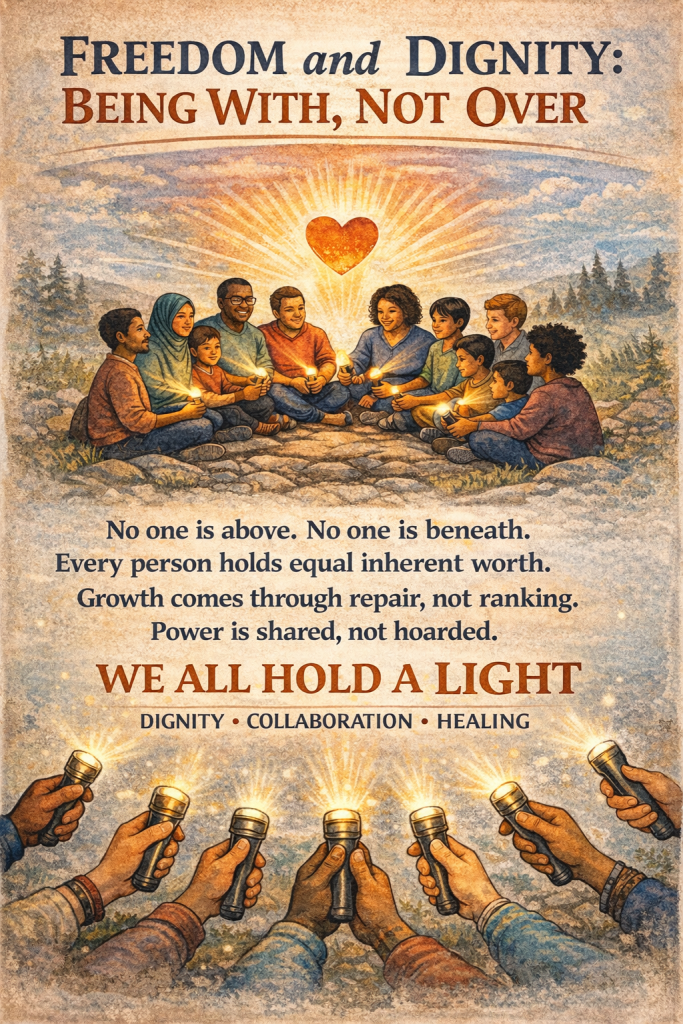
And the other truth is this: we all hold a flashlight. Not the same one — but a flashlight no one else can hold in quite the way we do.
Returning to therapists:
Seeing therapists as people
🦋reduces pedestal pressure
🦋allows for repair when mistakes happen
🦋makes therapy more collaborative
🦋keeps power dynamics healthy
🦋reminds us that growth is a shared process, not a one-sided performance
This does not lower the standard of professionalism.
It grounds professionalism in reality — and gives us all the freedom to be ordinary people with an extraordinary capacity for compassionate growth together.
To repeat this for emphasis — because this clarity is deeply dignifying:
When I say therapists are people with professional-level knowledge, I mean exactly that.
They carry tools.
They carry training.
They carry responsibility.
And they are still human beings walking through their own healing, their own triggers, their own growth edges — just like everyone else.
Remembering this does not diminish the profession.
It restores the humanity inside it.
It releases therapists from the impossible burden of being perfect, all-knowing, or emotionally invulnerable.
And it releases clients from the belief that healing comes from being fixed by someone “above” them.
This echoes the wisdom of Yeshua M’shīkhā — also called Jesus Christ — who warned against confusing good teachings with flawless teachers. Not don’t learn from them, but don’t put the pressure of idealism on them. Stay awake. Stay grounded. Stay relational. Stay compassionate. Our helpers lead us to dignity; they are not the way.
Therapy, like faith, was never meant to be a hierarchy.
It was not meant to be education through dominance. It was meant to be a relationship.
Two humans sitting together.
One trained to help hold their flashlight.
Both still learning how to live in the light.
And this — this levelling of false pedestals — is part of a much older seed in me:
Compassion over comparison.
Collaboration over control.
Shared humanity over hierarchical worth.
That seed is what makes real conflict resolution possible. Because when no one is trying to be above, we can finally be with. We can listen without defensiveness. Repair without humiliation. Grow without domination.
That is how communities of true belonging are built — not by perfect leaders, but by ordinary people, brave enough to stay human together, supported by regulations and processes that protect health, freedom, dignity, abundance, and accountability from the beginning to the end of our lives.
We do all this holding fast to the abiding truth: every child matters, and every part of the world we inhabit matters too.
Now apply this idea to every person in leadership in every position in our lives, parents; teachers; spiritual advisors; doctors; builders; managers; stylists etc. etc. etc. —including ourselves as the ultimate leader of our own choices.
How does this sit in your nervous system? Does it feel like we might finally able to move towards building and sustaining a thriving home together?
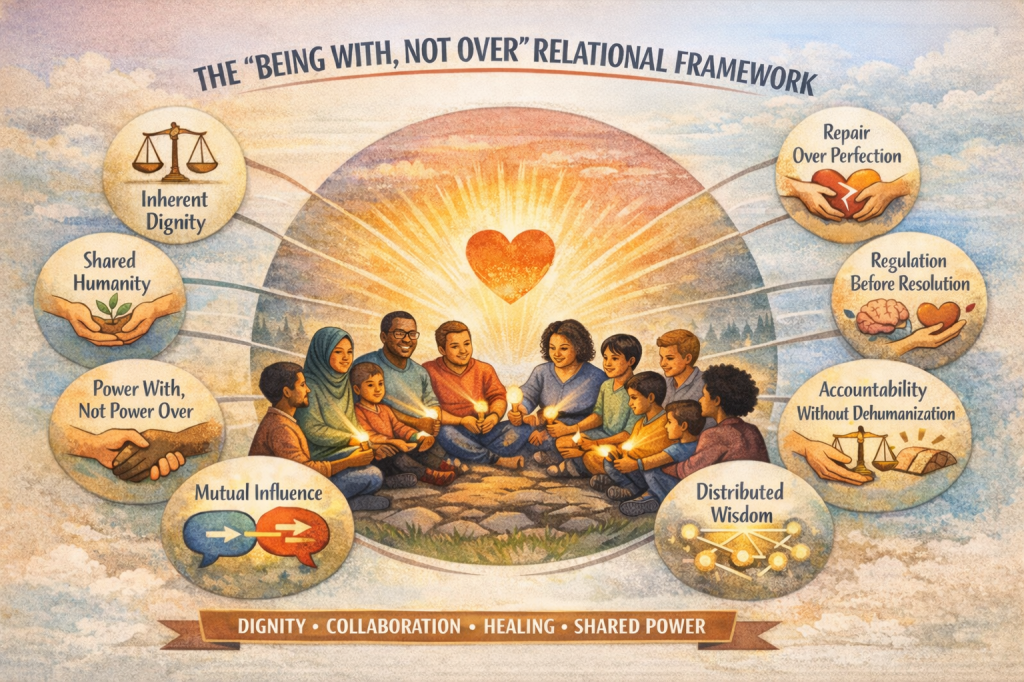
The “Being With, Not Over” Relational Framework
Eight Pillars
1. Inherent Dignity
Every person holds equal human worth, regardless of role, age, status, education, or capacity.
In practice:
- No shaming as a behaviour-control tool
- No using expertise to diminish someone’s voice
- No ranking whose feelings “matter more”
Dignity is not earned. It is recognized.
2. Shared Humanity
Expertise does not erase humanness. Leadership does not remove vulnerability.
In practice:
- Therapists can acknowledge mistakes
- Parents can repair after misattunement
- Leaders can say “I don’t know”
- We allow imperfection without collapsing accountability
This replaces pedestal dynamics with relational presence.
3. Power With, Not Power Over
Power is used to support safety, growth, and agency — not dominance or control.
In practice:
- Clear boundaries without humiliation
- Structure without dehumanization
- Authority that protects, not suppresses
Power becomes a stabilizing force, not a threat.
4. Mutual Influence
Even in asymmetrical roles (therapist/client, parent/child, teacher/student), both people affect the relationship.
In practice:
- Feedback is welcomed
- Repair is collaborative
- Listening flows both directions (within appropriate boundaries)
No one is treated as an object to be managed.
5. Repair Over Perfection
Relationships grow through rupture and repair, not flawless performance.
In practice:
- We name harm without shame
- We apologize without defensiveness
- We allow learning instead of exile
Repair builds trust more deeply than pretending nothing happened.
6. Regulation Before Resolution
Safety and nervous system settling come before problem-solving.
In practice:
- Slow the conversation when emotions escalate
- Co-regulate before correcting
- Recognize survival responses as signals, not moral failures
Connection restores capacity for collaboration.
7. Accountability Without Dehumanization
People are responsible for their impact — and still worthy of dignity.
In practice:
- Behaviour is addressed without attacking identity
- Consequences are protective, not punitive
- Growth is expected, not demanded through fear
Accountability becomes a path back into belonging, not a door out.
8. Distributed Wisdom
No one holds all the light. Every person carries perspective, insight, and lived knowledge.
In practice:
- Professionals respect lived experience
- Leaders consult those affected
- Families include children’s voices appropriately amplified
We all hold a flashlight.
What This Framework Creates
When these principles guide relationships, we get:
- Less defensiveness
- More repair
- Safer conflict
- Stronger trust
- Real belonging
- Sustainable collaboration
This is how homes, therapy rooms, classrooms, and communities become places where people can grow with dignity, without fear of being ranked, shamed, or dominated.
Freedom and Dignity: Being With, Not Over
A Relational Manifesto
We believe every person holds inherent dignity.
No role, title, age, education, or status makes one human being more valuable than another.
We reject systems built on domination, ranking, and control.
We choose relationships built on compassion, presence, accountability, and shared humanity.
We believe expertise is real — and humanness remains.
Teachers, therapists, parents, leaders — al helpers carry knowledge and responsibility,
and they are still people — learning, healing, and growing alongside everyone else.
We refuse pedestals.
We refuse dehumanization.
We refuse the lie that power must mean “over.”
We choose power with —
power that protects without humiliating,
guides without controlling,
and leads without erasing the voices of others.
We believe growth comes through repair, not perfection.
Through listening, not silencing.
Through regulation, not reactivity.
Through accountability that restores dignity rather than removing it.
We believe every person carries light.
Not the same light —
but a light no one else can hold in quite the same way.
When we stop trying to be above one another,
we can finally be with one another.
And from that place, conflict becomes conversation.
Difference becomes learning.
Responsibility becomes shared.
Belonging becomes possible.
This is how homes heal.
This is how communities grow.
This is how leadership becomes trustworthy.
Not through dominance —
but through dignity.
Not through control —
but through connection.
We are ordinary people
with an extraordinary capacity
to support dignity together.
 Nurturing Kindred