

August 18, 2026
In the days leading up to my birthday, I continue sharing the feedback that has helped me to grow; today’s offering is the idea that:
To get to peace, one important piece of the puzzle is to stop repeatedly asking closed people to become the witnesses that we believe we deserve.
Several years ago I was watching Grace and Frankie and was SO inspired by Frankie’s celebration of her birthday as Frankie Fest. My very good friend’s birthday was coming up and I had been wondering what to do to celebrate her with the kind of joy that our friendship had brought to me. And so the first friendfest was born. It was SO MUCH fun to find little ways to celebrate her each day until her birthday. I wasn’t really sure that I could do it, because there were almost forty days until her birthday. It was amazing though, how as each day went by I didn’t run out of things to say. And with each day of expressing gratitude for her the ideas of what to do to honour the final day grew.
It was so much in my wheelhouse because giving openness that honours each person is one of my very favourite things. I have always felt so constrained from doing that because I never felt like I had enough money to do that for all of the people in my life, and for everyone everywhere.
I used to feel highly stressed and like a huge failure at Christmas, because I always felt inadequate with not enough money to give to everyone whom I have ever loved. That’s a super duper long long long long list.
But as the years went by I began to learn that money is an investment in living life. I learned that I might not be able to give as many tangible gifts or as much money to everyone as I have always wanted to do. I realized that what I really wanted to do was to let people know how much they were loved. And I realized that the stress I felt was fear that the recipient would not understand just how much love was being given—and worse the bigger fear was that they would reject it or maybe even worse belittle it. They would not realize that I took their existence and their worth very seriously.
I sat with God because I was feeling so immensely overwhelmed that I felt like I was about to die. That’s burnout. I was so exhausted that the songs that used to bubble out of me had completely dried up. Completely. Every single breath and step felt almost impossible—like I was wearing the heaviest lead shoes. That’s depression.
And at the same time I was frantic. I couldn’t stop showing up. I’d be a failure. That’s anxiety.
I continued to live and continued to show up, wringing every drop of effort out of myself to be to the world the love that I feel for us all.
In 2012 for the first time I went to seek professional therapy. My professor, Jennifer, who almost immediately became my big sister, said to me that she could see the overwhelming wounds obstructing the flow of love and excellence that she could also clearly see in me.
I knew that I needed help; I just didn’t know WHAT KIND OF HELP I needed, and I didn’t know where to find it. She gently guided me to the Trinity Western University Counselling Centre.
Pause here with me.
It’s very important that I say this and as clearly as I possibly can:
I grew up with a very clear understanding that I was not all. That’s a wonderful thing to know. My parents had guided me to accept the openness that I felt to a higher comforting presence. And with what I believe was the best intention to keep me safe and well, and anchored in that presence’s lovingkindness, I was taught that I had to be “good”, and that goodness was the only thing acceptable to that higher comforting presence. Goodness was unintentionally defined as continuous perfection. That definition didn’t begin with my parents. It had been taught to them, as it had been taught to their ancestors, and their ancestors’ ancestors; it had been taught as far back as my ancestry could be traced.
Continuous perfection. A standard defined not by the comforting presence but by my ancestors. And we were driven towards that goal largely by judgment and punishment.
That definition didn’t even begin with my ancestors though, it began somewhere far in the past where all of our early ancestors were taught that no person was acceptable as a part of society unless they were visibly 100% perfect. I say all of our early ancestors were thus taught because what I have witnessed as a common leaning towards punishment and insistence on perfection implies this.
Then a multitude of rules began to be constructed, increasing with each generation, to define perfection. And we were driven towards that goal largely by judgment and punishment.
I was taught that to be continuously perfect all I needed to do was believe in that comforting presence to which I had been easily and comfortably open. I did believe. Deeply. Easily. Completely. And I was a child, a human, a person who learned by trying, feeling, making mistakes, receiving guidance, and trying again. I could not be continuously perfect because no child can be. No person can be. We grow in the ability to be skillful by doing, and failing, and trying again with the strength and the knowledge gained from the attempt before. But that’s not what punishment and judgment taught me. Punishment and judgment taught me not to be confidently human, it taught me to be increasingly afraid.
Because when I was inevitably human, I did not learn that the definition of perfection was impossible to attain; instead I learned to question myself. I learned that every mistake might mean that I had not believed enough, tried hard enough, listened enough, prayed enough, been good enough. The ordinary process of growing became evidence against me. The dissonance in that process is counterproductively crippling.
Therefore I learned to monitor, correct, and override myself. I learned to keep showing up long after I was exhausted because goodness had become something I had to prove.
And now come back with me to the beginning of guided therapy.
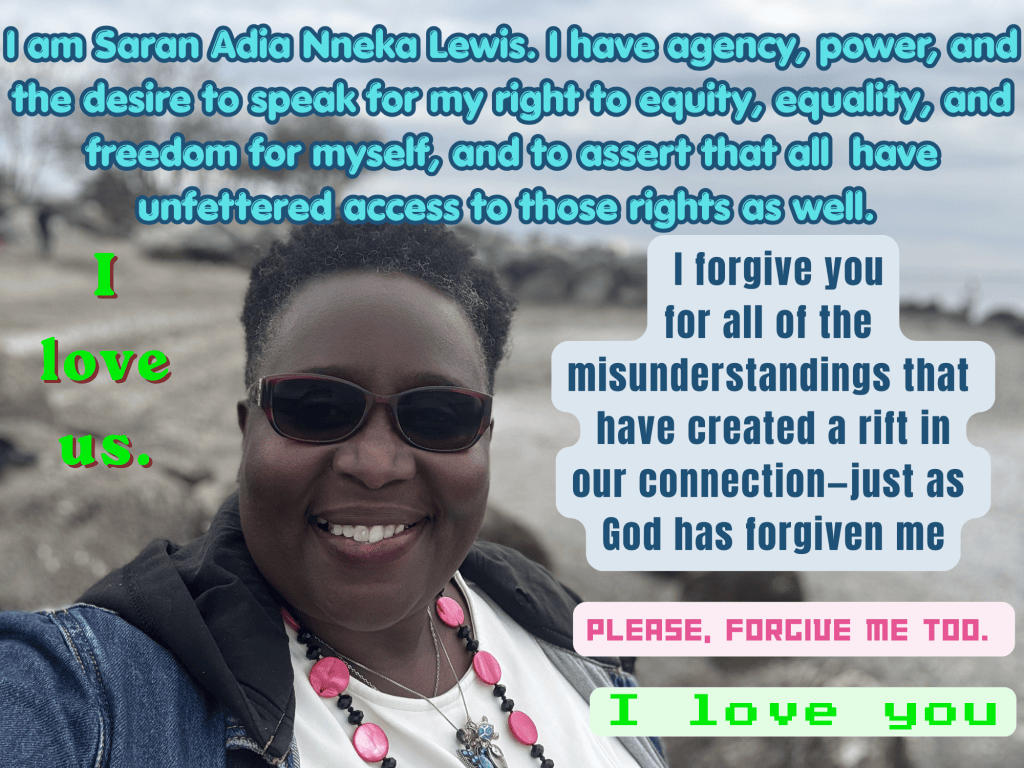
This has been long—it will be longer in another place—but I’ll shorten it today by saying that therapy in all the various forms to which I have been guided brought me to this one conclusion: that comforting presence, which some of us call God, loved us so much that they sent their beloved son as a messenger and teacher to tell us the truth about how much they loved us, even though they both knew that we’d be so entrenched in our belief, in our idea of perfection, that we would reject and execute the messenger. The messenger, Jesus, didn’t come to condemn us. He came to relieve us so that we could stop being so exhausted and anxious and have the opportunity to embrace his example of the comforting presence’s way of life. Peace.
And so in 2015 after years of therapy and listening to teachers speak of the way that our brains were really designed to work in harmony, to grow developmentally with each other, I said “God, I want my song back.”
Each day for a whole year, I awoke and the first thing that was on my mind was a song that I had known in the past. I wrote each one down, and journaled about it as and after I sang it. I wish I knew where to find that journal now.
I don’t need it though. Because eventually I began to sing and jam and enjoy life again. And as we began to look at the wounds, I began to let the messenger guide me through the Bible, to understand and become acquainted with the comforting presence again. And that’s where I had the amazing experience of being freed from “goodness”: from the well-intentioned but deeply flawed compounded definitions of being. There, God freed my fucks on my journey through the Bible with Jesus, and became my best friend.
Everything that I have done since, my passion for being with and sharing the joy of being with each other and supporting each other without feeling consumed came from that journey.
To get to peace, one important piece of the puzzle is to stop repeatedly asking closed people to become the witnesses that we believe we deserve.
We often remain remarkably open to reconciliation, even after serious harm. That is beautiful. That is a worthy goal. And we can become stuck waiting to progress until the person or institutions who have caused us harm are open to the full process of reconciliation.
And because being unanswered or dismissed is particularly painful for many or some of us, silence can pull us toward giving more explanation, seeking more evidence, and making more and more attempts to finally make the person understand.
Sometimes nonresponse is information.
We may need to move towards these steps:
🦋Make one clear request.
🦋Follow up once.
🦋Document what matters.
🦋Then choose escalation, boundary, release, or grief.
We can pursue accountability from persons and institutions without depending on the other party’s emotional recognition of our reality. Not every rupture will be reconciled, or not every rupture can be reconciled in the timeframe that we expect or desire, because reconciliation requires participation from both sides.
Happy almost-birthday to me.
 Nurturing Kindred