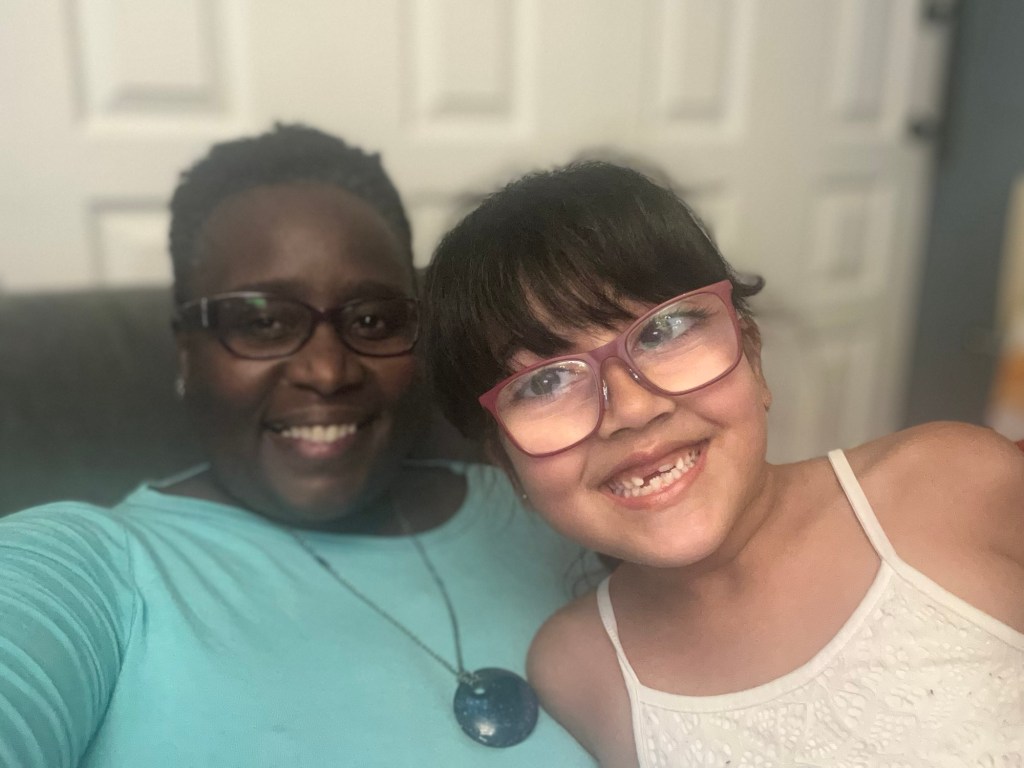
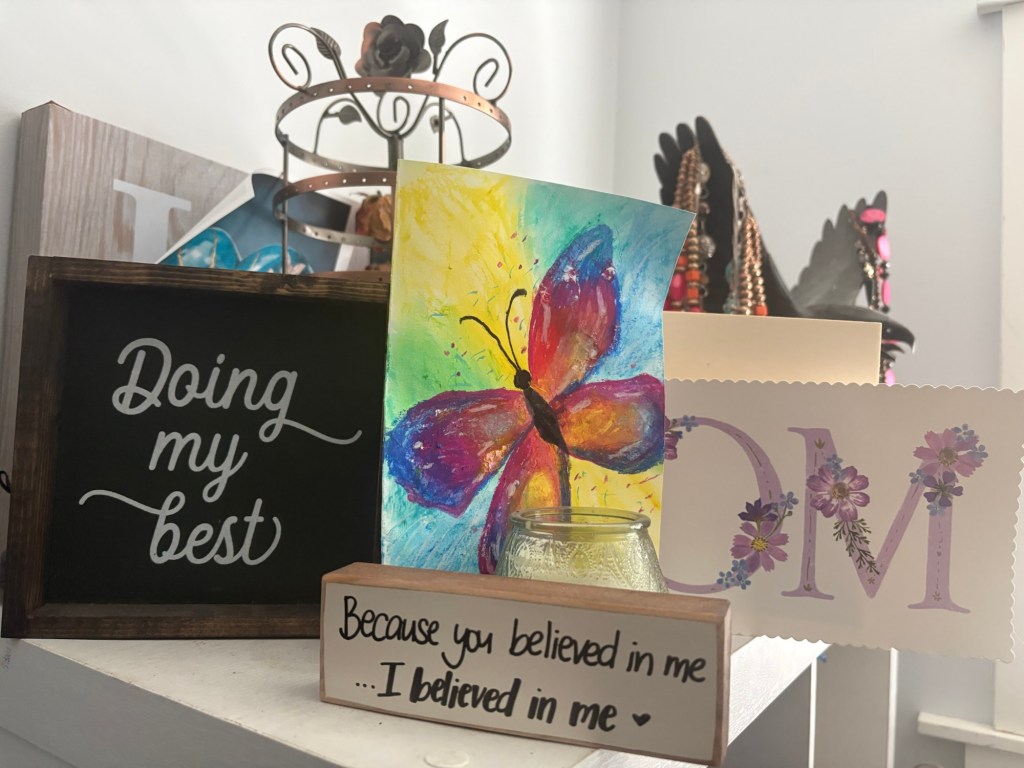
Author Archives: Saran - meaning: Joy, refuge, sanctuary

Unknown's avatar

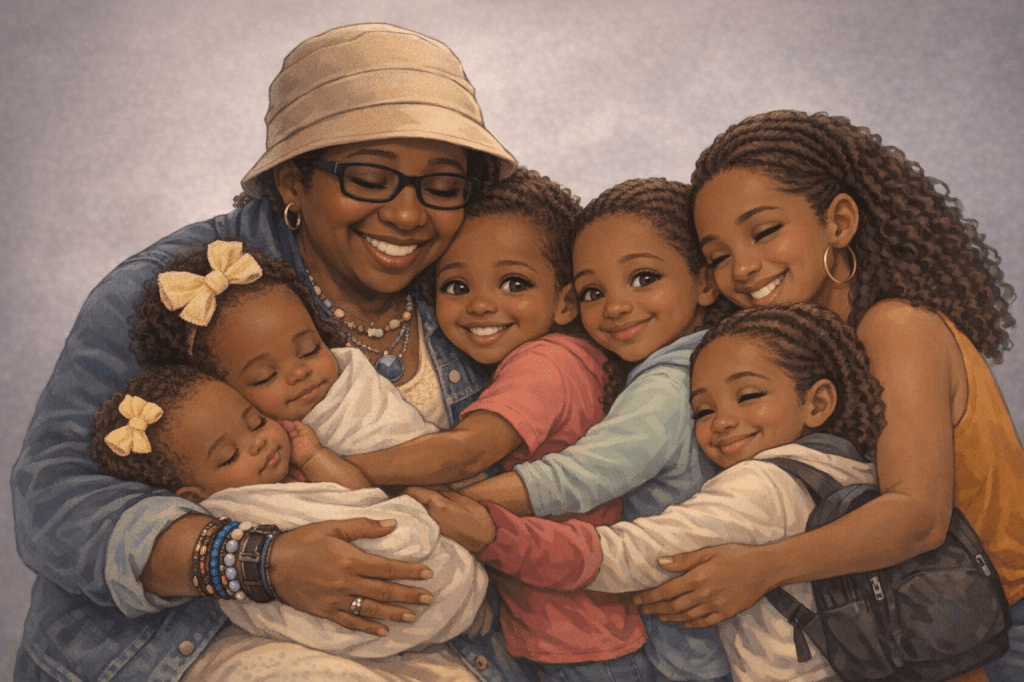
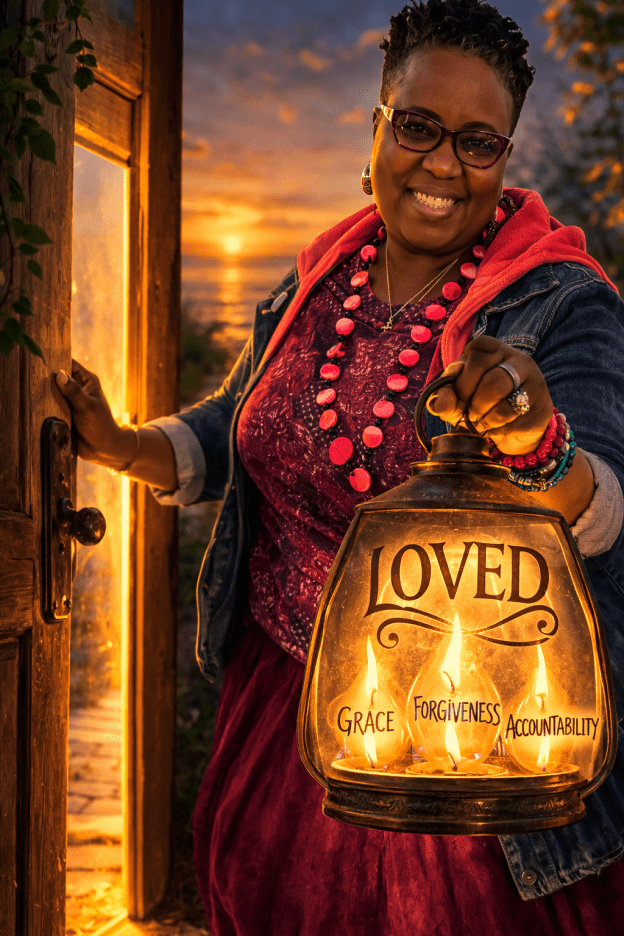
About Saran - meaning: Joy, refuge, sanctuary

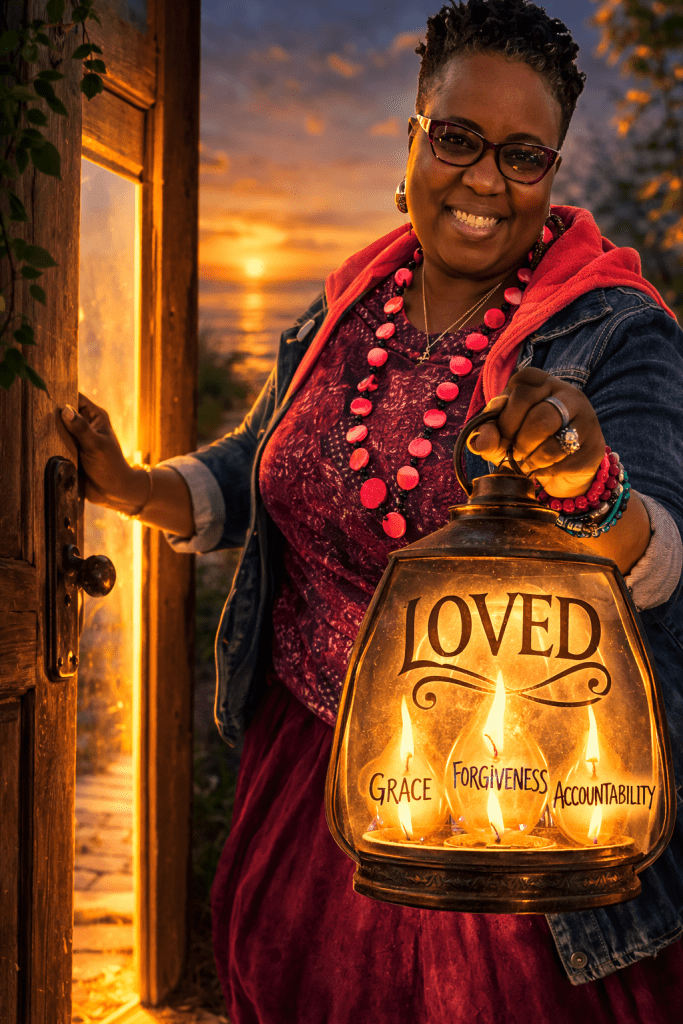
I have found love, and I live to share it. I have lived through and spoken peace to many big storms, and life has been beautiful. I believe that our individual stories are important building blocks in the beautiful communities that life was meant to be. For it is only when we share our stories, with deep compassion first for ourselves and then for each other, that we recognize that we are not alone, we are not very different, we are and have always been very much the same at the core - souls seeking to shine and enjoy the light of all others as we move through this human experience: “We’re only human and we’re looking for love... Human by Her Brothers. “ I believe in love, in the pure love modelled by Divine I AM, which is expressed in myriad ways, and in all ways is always perfect. https://youtu.be/KxluyC3JdCQ

Closer to Understanding the Peace That Is In “for self and not against other”.

Saturday, July 4th, 2026

Dudes, how much longer are we going to let money, scarcity, and fear keep us from experiencing the bliss of being with each other??

I know that this is a really simplistic question that completely ignores the factors which tear us apart. So let me explain what I mean. But first let me share that the big idea is that we can release our stranglehold on money as the lifeline that gives us worth and keeps us alive. We have chosen money as one of the tools with which we build our lives. Therefore when we let go of money as a lifeline it will move freely and profitably between us, and we will have the opportunity to then connect to the true source of life — the circle which includes all of us, everything that lives, and our Creator.

When I look at all of human relationship breakdowns to identify what caused the structure to begin to topple, I see money in the background as the ground zero source of infection. And it’s not the physical money that we hold in our hands. It’s money as a representation of worth and power and as the source of survival.

What if we remembered that we were here before money? What if we remembered that money is something that we made to organize our transactions?

What if we remembered that we always have what we really need?

What if we remembered that we are already very clearly seen?

What if we remembered that we do not need to be afraid? Aware? Yes. Wise? Yes. Afraid? Not needed.

If we took money out of the equation and organized our world by exchanging skills to help each other build the ideas that come to our minds, what would emerge as the most valuable and powerful thing?

Drum roll? 🥁

We would. We would be the most powerful and valuable thing.

And what are we? We are:

•Our minds.

•Our ability to communicate.

•Our respect for each other.

•The patience that allowed us to wait for an idea to fully come alive.

•The gentleness that held us safe as we waited, and comforted us when waiting became difficult.

•The self-control that harnessed anxiety and reminded us that we just need to wait our turn.

. The faith that believed that we would figure it all out.

•The joy that helped us to laugh and have fun while we build and while we wait.

•The love that is like a cozy blanket which keeps us perfectly warm and perfectly cool and perfectly grounded. Can you feel that blanket? Can you visualize it?

•The hope that knows that all of these things will always be replenished.

•The experiences that helped us to strengthen all of these parts of ourselves.

•The goodness that helped us to share with certainty that we would have what we need when we need it.

And we’d see that goodness is the peaceful state that allows us to connect to patience, gentleness, faith, self-control, respect, communication, love, hope, and each other.

  • What if we remembered that before there was money there was a Creator who equipped us with everything that we needed, and enjoyed watching us explore the world, and enjoyed watching us come up with new ways to put things together?
  • What if we remembered that we invented money as a part of our exploration? What if we remembered that money does not preserve our lives?
  • What if instead of loving money we loved us?

What would change for us then?

Would we able to rest?

Happy Sabbath. I say happy Sabbath because I am writing this on the seventh day. A day which I receive as the Creator’s original built in weekly holiday designed to fully embrace rest. Not because it’s Saturday but because I see the value in the cycle of six days of work followed by a full day of rest. Rest is the gift that allows us to slow down and remember. We are not poor. We have and will have everything that we need. Sabbath is not a religious idea. The Creator attached no punishments and restrictions to the day. It is a gift which we are invited to accept. Let me pause here to clarify this thought.

Rest is not owned by religion.

To be clear, I am not speaking from a Christian worldview or from any other religious perspective. I am speaking from what I think is the perspective of our sustaining spirit’s heart: from a spiritual perspective.

As I observe the world I see that people co-opted relational virtues and placed them into a container called religion, then distilled this idea further to create a hierarchy which elevates religion as the only space where people can become virtuous.

People made religion the only container in which perfect harmony is held. As if that is even remotely possible. It’s like building an aquarium and then insisting that the aquarium is the ocean.

I’m not looking at religion I’m looking at what causes fragmentation in a community and looking at what qualities create a thriving, vibrant, hopeful and healthy community.

So returning to the framework of healthy community:

Accountability is the part of relationship that calls us back to remember what wholeness and thriving looks like.

Forgiveness is the part that understands that we forgot.

Power is knowing that this is all true and possible.

Peace is understanding that we cannot force anyone to remember. We all remember when we can. And so we embrace all that we are, and do no harm.

Sin is forgetting. Forgiveness understands. Grace creates space for repair of the wound that forgetting caused.

This is what I mean when I say that God freed my fucks, and became my best friend on my journey through the Bible with Jesus.

Because the Bible is a record of the story of humanity’s beginning, which pivots to the experience of one community from its inception through its journey in relationship to other communities, and then it ends with the promise of complete relational restoration.

And through that story I found peace in the consistency of God’s well regulated presence which continued to be with humanity through much misunderstanding and confusion mixed with some understanding. I saw that humanity consistently legitimized its adulterated harmony by claiming that its interpretations and practices are fully congruent with God’s pattern of being. And Jesus came to remind us what was truly legitimate. But we killed him. He let us do that because he knew that his survival did not depend on our actions. He chilled for a bit, and then got back to business having been restored to life by the giver of life.

God accepts my rage, allows me to pour it all out instead of imploding with suppression, and is completely unoffended throughout the process. They’re the ultimate well regulated parent. Their one request is that I learn to slow down and bring my rage to them, instead of unleashing it on to others.

They don’t punish me for my rage or for the things that I do and say when my mind is flooded and overwhelmed and I get stuck in flight, freeze, fawn, flock, or faint.

They help me to repair. They help me to restore. They help me to figure it out. And they help me to rebuild when I’m ready.

This is us.

We keep wrecking the home which was designed to be the space in which we have this experience, so God keeps showing up to patch it up and heal the wounds that we got when things broke. And when we get to the place where we mess with the chemical balance and burn the house down They’ll come back to rescue us, and take us to the new home that They’ve had waiting for us.

It would be super foolish to fight being rescued and stay in the burning house to try and save our money and the things that we got with money. But some of us will do that.

I wish we wouldn’t.

#NurturingKindred #TheForgivenessFramework #LessonsFromJesus
https://youtu.be/zY5o9mP22V0?si=–oTkbxX9L1Ll8Dz

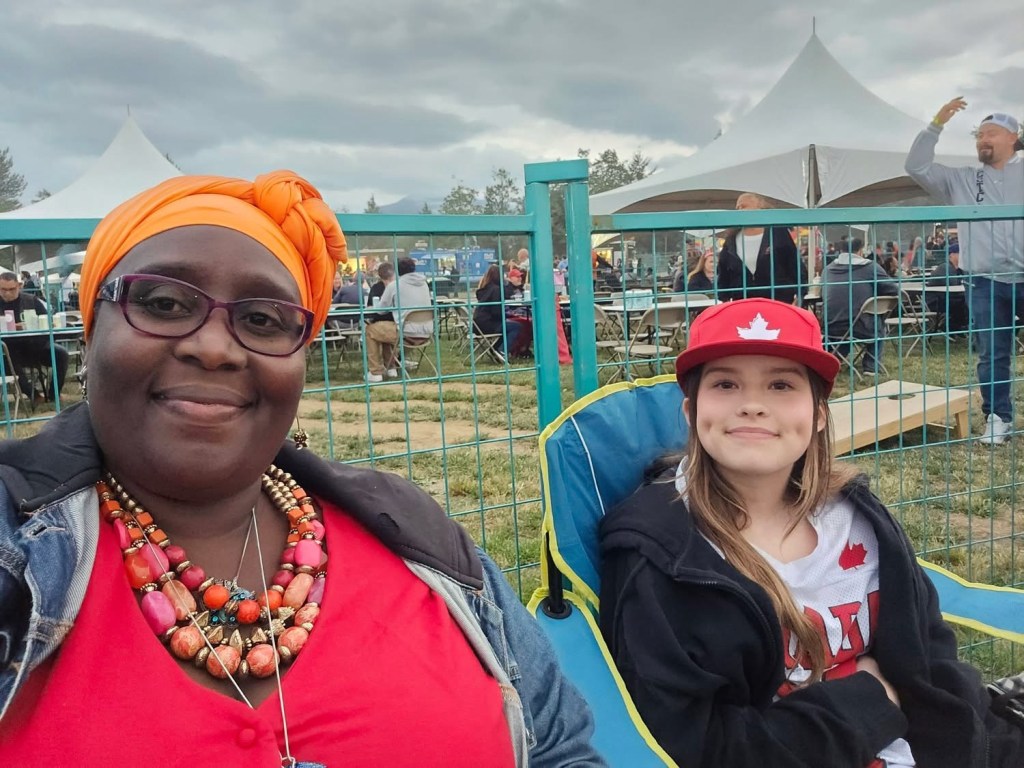
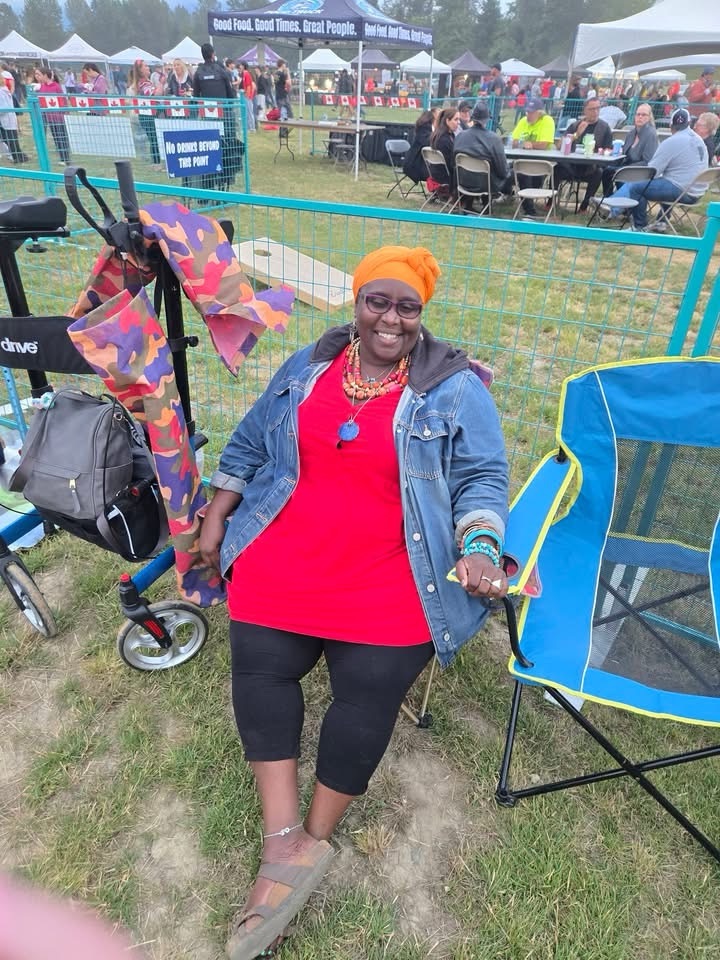
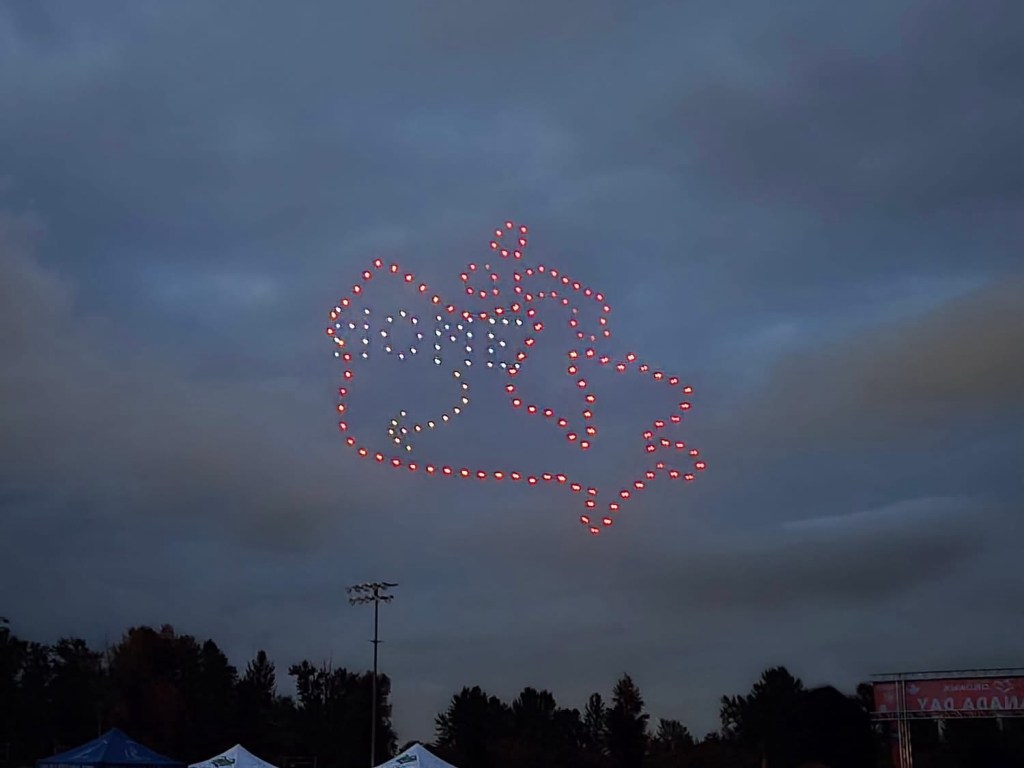
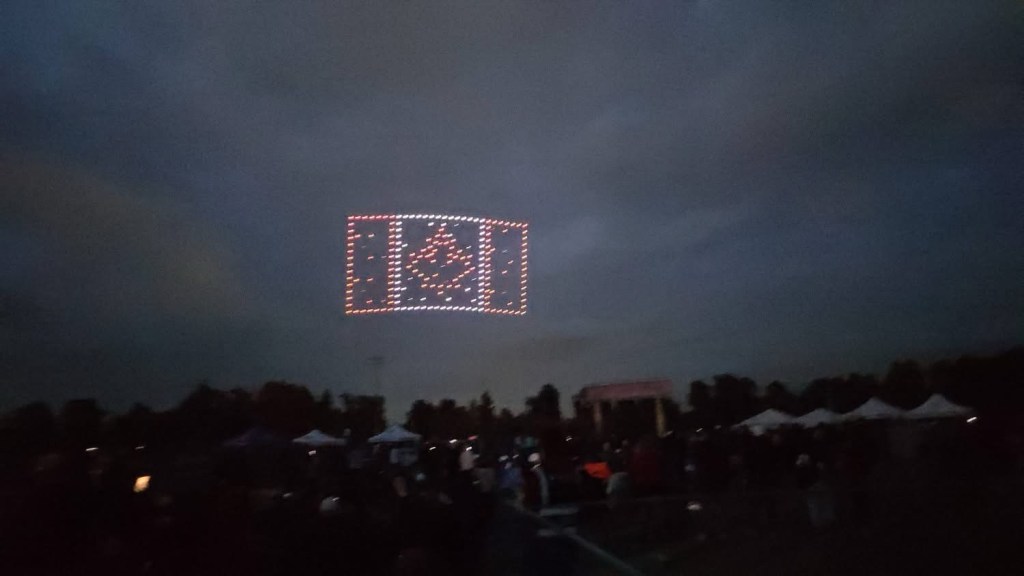
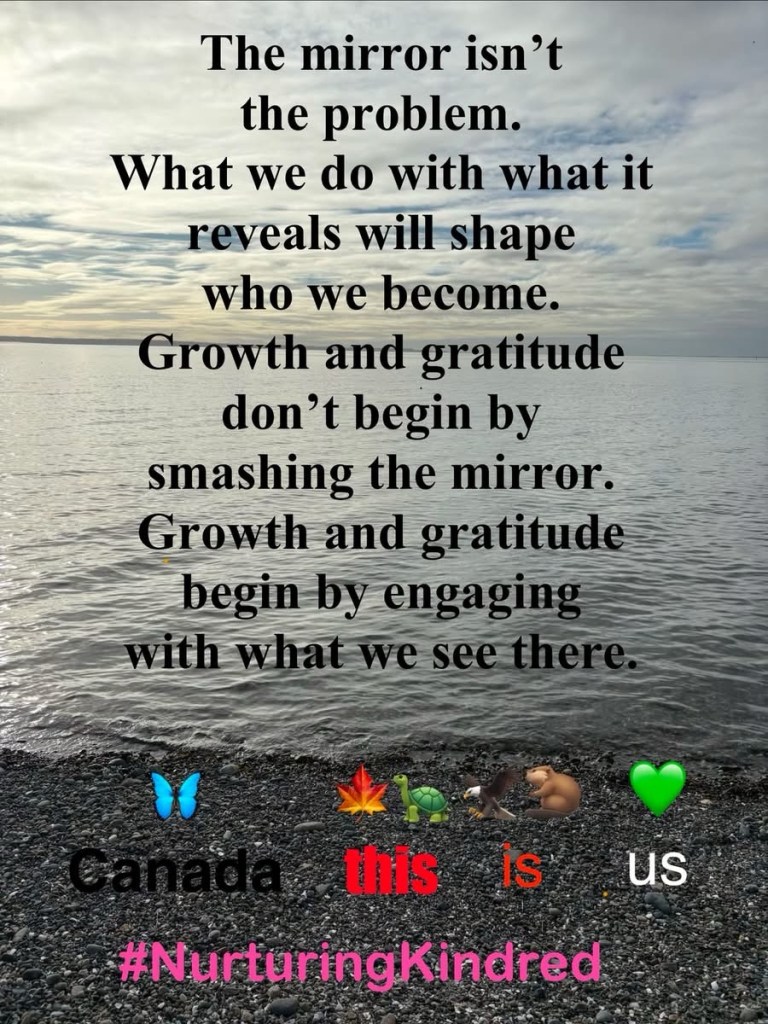
Moving Courageously to Belonging and Wholeness. Happy Canada Day.

I know that gratitude belongs, and it always does. If we live with gratitude and connection to whom we are, everything, even when we have been deeply wounded, can begin to be profitable. We discover possibilities for growth. Growth is profit.
Therefore when we are hurt and need to move into survival mode to remain alive may we remember to return to gratitude and connection so that we can begin to heal and grow optimally again. This is the message of my heart every year on Canada Day because this day is a representation of the complexity of suffering mixed with gratitude which allows us to thrive as we move through the world. As the descendant of formerly enslaved people who struggle to find a way to be free and resilient in a world which is still wrestling with hierarchy and oppression—I see you. I see us. I see possibility.

Life is complex. When we experience pain our attention moves to what causes pain so that we can survive. Depending on the severity of the injury we forget about everything else to focus either on saving our lives or fighting for our ability to function well. Our vision narrows to focus on the thing that we must survive. Our system pauses all functions that are not essential to survival.

Focused on survival we forget joy. We forget gratitude. We even forget the need for nourishment. That is natural. That is right. Without this we would not continue to exist so that we could have the opportunity to heal and grow later.

Today is Canada Day. For many generations we have been focused on survival as a nation of settlers and Indigenous People, whom settlers attempted to dominate and force to assimilate to settler ideology after The People welcomed settlers to this land. Settlers may have forgotten, as it seems we typically tend to forget, that when we harm others we harm ourselves, because at the core we are one. So we all hurt.

Therefore what was done did not only hurt those who were oppressed. They struggled to survive with the excruciating pain of attempted erasure. And all who witnessed the pain, caused it, or lived in a nation affected by that pain suffered the loss of innocence which ruptured the connection that would have made this nation stronger as people working as equals together.

What we may not realize is that everyone who witnesses injustice lives with ruptured innocence, for life will never return to what it would have been without the experience of the resulting pain. Shattered, it cannot be what it once was. And yet with accountability for injustice, we make the space to create something restored. Something stronger can be constructed which will stand as a monument to the recognition that justice and integrity are pillars of a nation’s fullest prosperity—where optimum profitability hinges on the lived experience of each person’s autonomy and agency.

As a nation, Canada has moved past pretending that our complex history is not real. We began to face this truth together. Yes, some still pretend that there was no harm or that we are fully healed. And as a nation we cannot allow ourselves to be pulled back into pretence. We will be stuck in survival or inability mode if we do that.

With the vision of possibility in mind, I encourage us to keep moving forward, Canada. And while we move forward may we remember to go back to gratitude for everything that is wonderful about us. May we together grieve what was lost, and may we return to joy. Together.

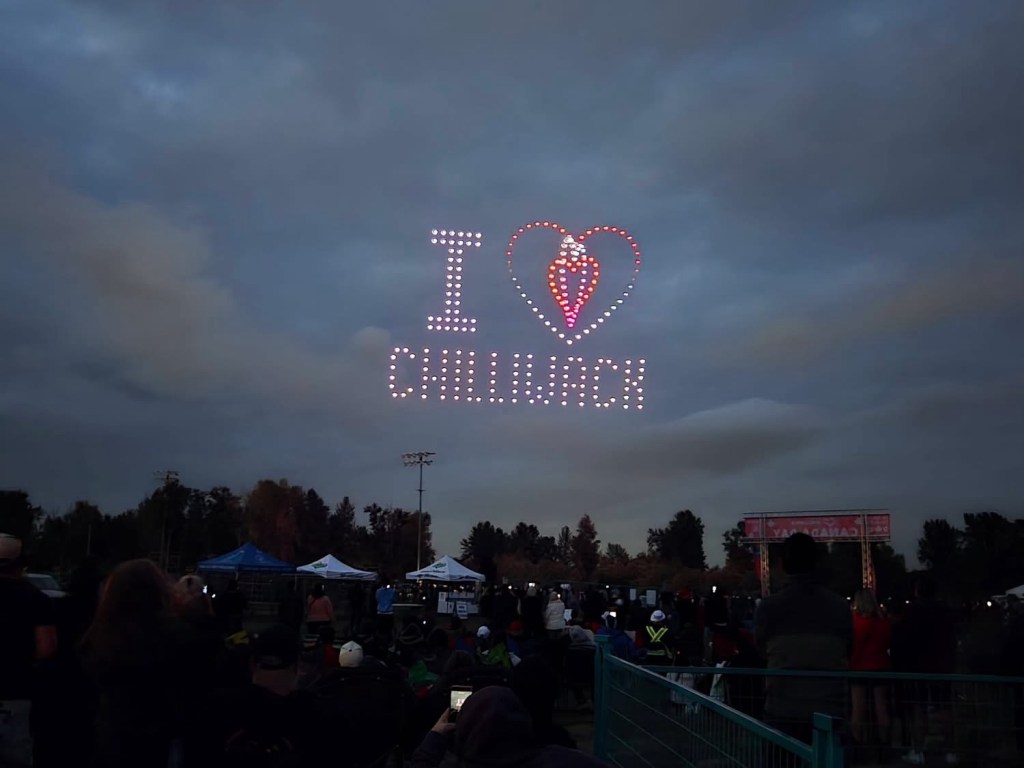
So much is possible if we can do this. Living in Chilliwack for the last two years has given me the opportunity to experience the nation moving forward together with the joy and the struggle that is a part of the process. This community lives with extraordinary hope and intention towards the profit to be gained from togetherness when we embrace belonging and freedom as the birthright of everyone who calls this place home. I don’t take that lightly because I am keenly aware that whether we are Indigenous Peoples, settlers, or newcomers we had to choose to wrestle with the past to arrive in the present with hope for a prosperous future together.

It seems that we have recognized that a journey towards freedom and togetherness must hold space for both restoration and transformation. And these processes take time. Observe anything healing and that truth becomes clear. Observe a butterfly in each stage of its development and it becomes clear that each stage of development plays a role in the final emergence of the butterfly. I believe in us. I believe that we can move through both restoration and transformation to become a nation united and profitable together. However, as my parents reminded us in our family pledge we must all choose to do this with intention, determination, and practice.

Mommy and Daddy brought this idea to us: Effective family life does not just happen. It is the result of deliberate intention, determination and practice. And I pledge with God’s help to do my part to make this family life effective.

That was neither a short-term goal nor an easy process. But they had faith in our ability to make their vision of our wholeness a reality. I still believe in that possibility for myself, for our family, for our nation, for the world.

I love you neighbours, and I also know that to reach the goal of wholeness we need to keep acceptance, accountability, forgiveness and openness as essential pillars of the process.

What the f*ck are we waiting for, man? Forgive each other already and let’s do this. 🫣I’m eager 🤩 and I’m also determined to continue to learn to be patient. 🥰

Oh Canada, the home in which we stand, moving courageously through pain and fear to belonging and wholeness. Happy Canada Day. I’m grateful that we moved from Dominion Day to Canada Day. That showed intention. Let’s keep building forward together.

#NurturingKindred #TheForgivenessFramework #Celebration #Reconciliation #Progress #Togetherness

On Releasing Being Truth

I am human. We are human. Let’s begin there.

And here is the big idea:

When communities teach children that they are the holders of ultimate truth, those children will unintentionally inherit pressure, anxiety, and unconscious superiority.

That is because we have placed on the children a burden that is far above their pay grade. We place on them the same burden that was placed on us—a burden that many of us carry to the third and fourth generation. What is that burden?

We tell them that we, and only we, are the bearers of divine truth.

We tell them that no one else has truth like we do.

And we tell them that we are tasked with guarding that truth for a Master who will punish us if we deviate from it.

This creates a traumatic inheritance of anxiety and arrogance.

It robs us—and it robs the children—of the opportunity to live as loved, learning humans.

We are human, and I think that matters more than we sometimes allow it to matter.

Because when we forget that we are human, we begin to imagine that our thoughts are pure, linear, and perfect simply because these thoughts originate in us—guardians of truth.

We begin to imagine that our intentions are undefiled simply because we meant well.

We begin to imagine that the harm in the world is mostly caused by other people—people who are ignorant, cruel, lost, defensive, incompetent, blameworthy, shameful, and less perfect than we are.

And that is a big part of the problem.

The live video below may seem chaotic, unclear, or disrupted. But what it reflects is something real about being alive.

It is a living reflection of the awe and wonder we can experience together—alive and in relationship with the natural world, with the things we have created, and with the mystery of being created beings ourselves, without perfect clarity.

It is the experience of living in connection with our Creator and with each other. And that kind of connection is profoundly profitable.

Not profitable in the narrow transactional sense that we often associate with economics, but profitable in the deeper sense of mutual flourishing. When relationships are rooted in humility, truth, and love, the result is shared wellbeing—spiritually, sexually, emotionally, socially, and materially.

This kind of prosperity is transformational rather than transactional. It is the kind of prosperity that healthy communities were always meant to cultivate together.

The video begins with a moment of shared wonder as we observe a magnificent eagle perched—and then soaring—from the highest point of a majestic tree at my very favourite place: Crescent Beach.

From there, we begin to explore the truths of our stories, and the danger of believing that the part of the truth we hold is the whole truth that exists.

And we turn to Jesus’ invitation to live with humility and respect for the many stories that shape our human experience.

I invite us to recognize the value that each of our stories brings to the world. I invite us to learn from our stories, and I invite us to recognize that there are as many stories as there are living things—and all bring a part of truth to the world.

And I also invite us to recognize something even more important.

Our Divine Creation Team does the heavy lifting in the work of revelation and healing.

They ask us to cast that burden onto Them.

That is not our job.

We cannot carry that weight.

We thrive when we accept their invitation to become partners—when they fulfill their role in the Big Picture, and we faithfully fulfill ours.

In Romans chapter 3, Paul speaks of the Jews having the revelation of God.

But is Paul correct?

What impact did the idea of having the revelation of God have on Israel?

And what impact does the belief that our revelation is the truth have on individuals and communities today?

When Jesus asked, “Should we take the children’s bread and throw it to the dogs?”was he affirming Israel as “the children” and defining all others as “the dogs”? Or was he challenging the nation’s supremacist assumptions—and inviting everyone present to recognize themselves as children?

These are important questions.

And they bring us back to something that matters deeply.

We must be very careful about the stories we tell the children.

And we must be equally careful about the way we live our stories in front of them.

Because the way we tell and live our stories shapes how children experience the world.

When we present our story as the only truth, we unintentionally place a heavy burden on them—the burden of believing that they must carry truth for the world.

That burden easily grows into superiority.

And superiority, even when it grows out of sincere belief, leads to contempt.

When contempt enters our hearts, it robs us—and it robs our children—of the joy of living in peace and shared progress with all the children of God.

So I invite us to witness this moment of shared awe and wonder with the community as I share my testimony, my questions, and my reflections on this big idea.

The moment began simply.

For several months I had been trying to get to my favourite place: Crescent Beach. Two Saturdays ago, on March 14th, I finally made it.

As I arrived, I saw a man who is Sikh standing beside where I parked, his head tilted upward, his phone raised and focused on the top of a magnificent tree.

He had noticed the eagle first.

High above us, perched at the very top of the tall, majestic tree, the bird sat with quiet authority—still, watchful, completely at ease in its place in the world.

I grabbed my phone, exclaimed in delight, and clambered out of the car to find a spot where I could witness and share the moment.

And as we stood there together—strangers, friends, passersby—the conversation stopped. We were largely quiet. Heads tilted upward.

For a moment, we were simply human beings sharing wonder.

We were standing together at Crescent Beach—one of my favourite places in the world—watching the tide breathe in and out along the shore. The air carried that familiar mix of salt and wind that seems to open something inside the human spirit.

Then the eagle moved.

With sudden and effortless grace, it spread its wings and lifted into the air, leaving the tree behind and rising into the open sky.

And in that moment, something beautiful happened among us.

People laughed in delight. Someone gasped. Others pointed as the bird caught the wind and began to soar.

We were different people, carrying different stories, different beliefs, different questions about life and God and truth.

And yet, in that moment, we were simply a small community of humans standing together in awe.

That moment inspired and encouraged me, because it reminded me of something important. Human beings were not meant to live as isolated holders of ultimate truth, defending our small pieces of certainty against one another.

We were meant to stand together in wonder.

We were meant to learn from one another’s stories.

And we were meant to soar together.

It was the perfect moment to share the thoughts of my heart that continue to emerge as I live in relationship with God and with all of us, as we seek to become a truly inclusive community that embodies belonging.

My Crescent Beach experience became so much more than I could ever have asked, dreamed, or imagined, and I hold faith that our communities will similarly become more unified in the love of God, and we will soar together, finally embodying belonging more than we had ever asked, dreamed, or imagined.

XO. I love you.

Saran.

Being Truth or Learning Truth — the Love Journey.

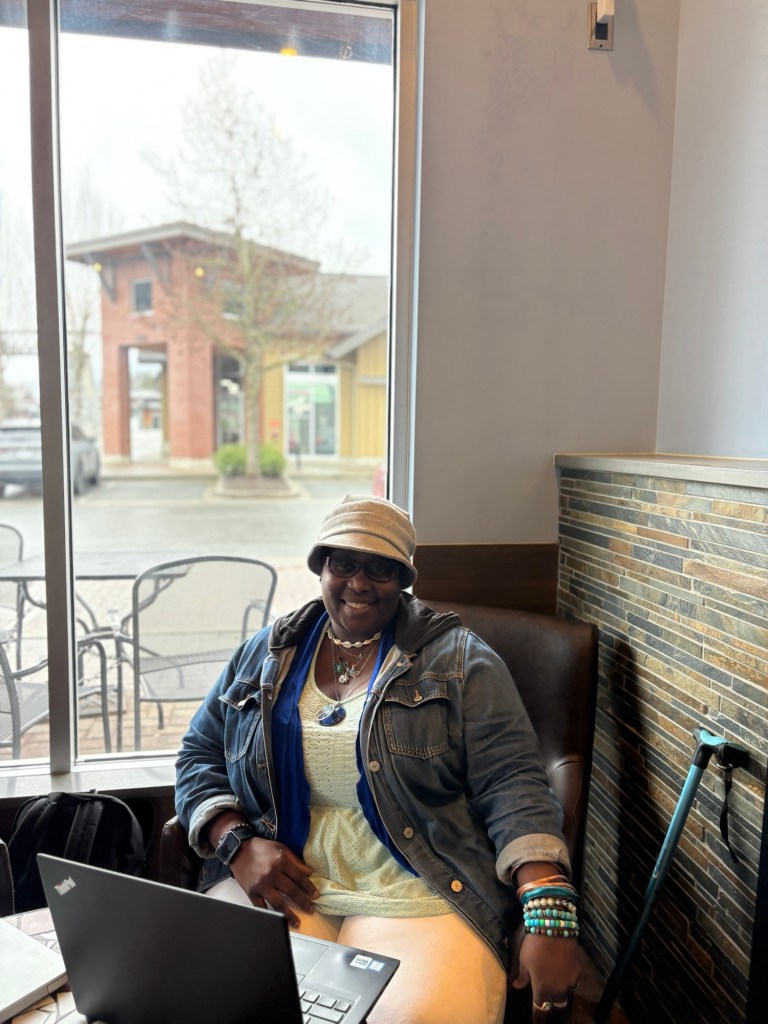
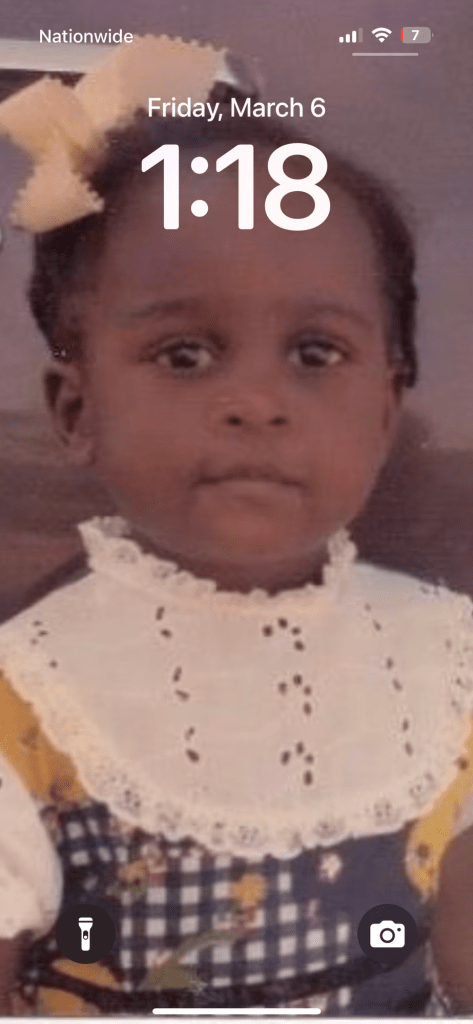
Today is March 13, 2026. A week ago I was at a meeting with Anjali, and the day had been so full of everything good — including conflict resolution that ended with acceptance. I asked her to take a picture of me. And then as I looked at this picture of little me which is on my phone screen to remind to me to be as gentle with myself as I would have been gentle with her…

I felt so at peace. I felt as if every version of me, at every stage, was safely comforted and accepted by the me I am today.

I recognized that I have always been assertive and unafraid to engage with people because I have always seen us all as beautiful little people who belong here.

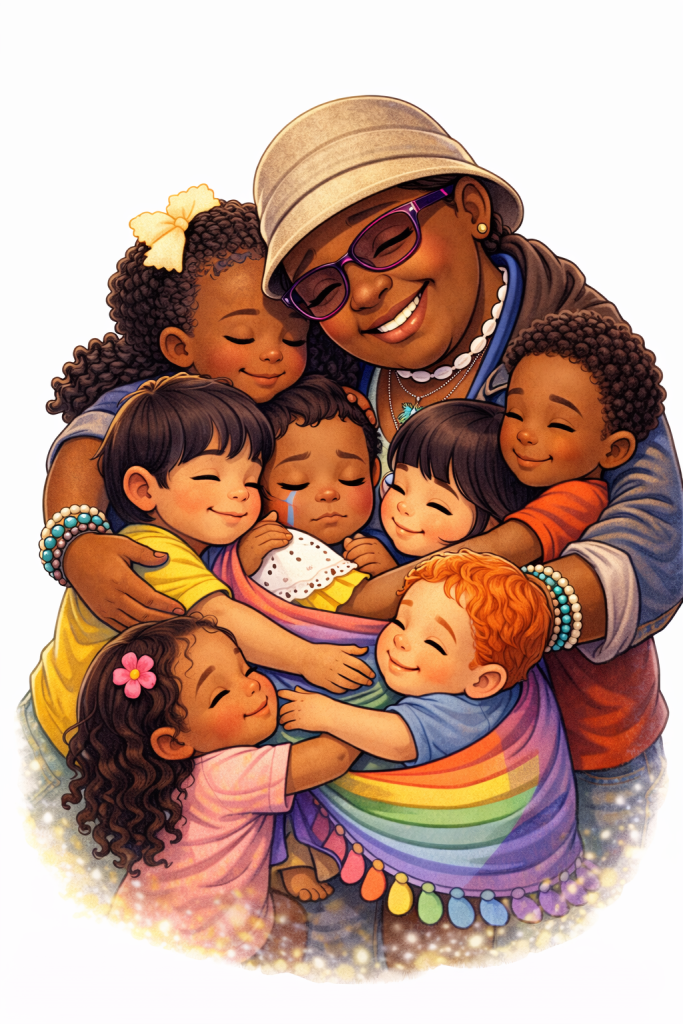
For a while I struggled with fear about whether or not we all really belong. I struggled to believe that I belonged. And one day several years ago as I was meditating, I saw a vision of my little self lying terrified in the dark. As I looked at baby me, the Spirit said: “You know exactly what to do with that baby.” All of me smiled as I recognized that I absolutely knew. I picked her up and hugged her.

That is how I see us. I see the terrified little one in all of us, and in my heart I do pick us up and hug us.

And as I continue to observe the world I realize that we have been immersed in some ideas that have affected our ability to be together in real love.

I have heard it said that the enemy of one’s enemy is one’s friend.

This idea has shaped many of our alliances, our politics, and even our relationships. We often bond through shared opposition rather than through shared love.

But Jesus said something very different.

Love your enemies.

Bless those that hurt you.

Pray for those who despitefully use you.

At first this teaching seemed almost impossible. How could anyone genuinely love those who cause harm?

Over time, however, I began to notice something difficult and humbling.

I have learned that I hurt myself and despitefully use myself more than anyone else ever has—and God keeps guiding me through accountability with myself for this.

And it was on that gentle journey of accountability that I began to learn to love.

This growing me forgave and gave grace and comfort to all the younger versions of myself—from birth to this present day.

I learned that more than anything else I needed to forgive myself for the ways that I had harmed the younger versions of myself.

I needed to give myself the grace to continue to belong, because now I know that I did not know then what I know now.

It was on that gentle journey that I began to see that defensive-loyalty had been very often misrepresented as love.

I learned that love does not pretend that harm did not happen.

Love protects with wisdom.

I learned that love does not turn away from injustice.

Love gently and boldly speaks the truth.

I learned that love is the willingness to look honestly at oneself without feeling shame.

I learned that love knows, embraces, and welcomes the opportunity to emerge as a new creation with truth learned and justice installed as often as is needed — seventy times seven.

Because on that journey the Holy Spirit taught me two primary skills:

1. To accept being wrong.

2. To accept being perceived as wrong.

Learning both of these skills was difficult, because accepting that I might be wrong required courage and openness. I had to consent to allowing God to prune aggression from assertiveness.

Accepting that I might be perceived as wrong required something even deeper. I had to learn to remain open and peaceful even when misunderstood.

Then the Spirit taught me something even more freeing.

They taught me how to listen.

To listen I had to choose to stay in — rather than run away from uncomfortable conversations and processes.

Through listening, I began to learn what was right—not through shame, but through curiosity and grace.

For much of my life I had believed that accountability would lead to condemnation. Instead, it led to something completely different.

As I experienced God’s grace and forgiveness through the process of accountability, God gained my trust, and became my best friend.

And that is where I began to understand what it means to love the Lord my God with all my heart, soul, mind, and strength.

There I learned to love myself.

And from there I began to learn to love my neighbour as myself.

Because when shame, defensiveness, anxiety, fear and similar emotions and states of being are filtered out of our lived experiences and replaced with awareness, clarity, hope, discernment and similar emotions and states of being we become open to learning. And when we become open to learning the growth of love in and between us becomes possible.

And it was there that I began to understand the difference between being a co-shepherd and being a hireling who is unconsciously focused on personal glory and reward instead of on the good way of mutual profit and care.

A hireling protects reputation.

A co-shepherd protects people.

A hireling invests in being right.

A co-shepherd invests in healing.

And in that realization I finally understood something that had once confused me.

I understood how deeply damaging it is for us as fallible human beings, as individuals, as countries, systems, or organizations—to claim to be the truth or claim to know all truth.

Truth is something we grow toward together through humility, listening, correction, and grace.

Anyone who claims ownership of truth will eventually begin protecting their authority instead of protecting people.

But when we approach truth as learners—when we allow ourselves to be corrected without shame—we become something else entirely.

We become neighbours.

We become friends.

We become co-shepherds who hold space for others to join us on the journey to the green pastures of love.

And along that journey may we begin to see what we may have forgotten before. Inside of each of us is still a small child who only needs someone to pick them up and assure them that they belong here.

We’ve got this. We know exactly what those little ones need.

We need to allow the One who is all love to pick us up and welcome us with a hug.

The House With Many Doors—This is My Story

https://youtu.be/1TKAN-nAsu8?si=U1R5CnfPpJMe40j_

There was once a great house on a hill, built by a Master who loved every person who entered it.

The house had many doors, each one leading to a room prepared for someone to grow, rest, and learn to love.

But long before the current residents arrived, a whispering voice wandered through the halls.

It told the first occupants:

“The Master is holding something back from you because he wants to control you.

You are not safe here.

You must protect yourselves.”

And so the people began to close their doors.

The whisperer created a coalition of other whisperers, and they spent their time wandering through the house, whispering stories of discord and fear.

And so the people locked their doors.

As they repeated the whisperer’s stories about the Master, the room-owners began to be more afraid.

Then they pushed furniture against the doors and told their children that although the Master had made them a house, and made for each of them a special room, he was not to be trusted, because he withheld good things from them so that he could control them .

Soon each person lived in a private war, afraid of the Master and also afraid of each other, convinced that the others were aligned with the Master, and so were to be feared as enemies, not trusted as friends.

The whisperer never touched a single door.

He only told stories.

The people did the rest.

The Steward

One day the Master appointed a Steward—not to rule, but to serve.

She was given no keys, no authority to force doors open, and no power to punish.

Only this instruction:

“Keep the lamps lit.

Keep the hallways warm.

And when someone opens their door—even a crack—meet them with a love lamp.”

So the Steward did as instructed.

She cared for the lamps.

She repaired the hallways.

She filled the pantry.

She kept the house running even in the times when she believed the story that others had left her alone.

Sometimes the residents blamed her for things she had not done.

Sometimes they accused her of motives she did not have.

Sometimes she felt like they took without giving.

Sometimes she certainly got things wrong.

Sometimes she did not know what to do.

And each time, the whisperer smirked in the shadows.

The people behind the doors believed that she was aligned with the controller too.

The Steward’s Own Messy Room

What the residents did not know was that the Steward herself had once lived behind a locked door.

Her room had been cluttered with old fears, unhealed wounds, and the debris of stories she had believed about herself and others.

The Master’s Friend had come to her door many times—not with force, but with a gentle knock.

When she finally opened it, even a little, she expected anger.

She expected disappointment.

She expected judgment.

Instead, the Friend stepped inside with a lamp and said,

“You can be loved and messy at the same time.

You can be joyful and still learning.

You can be free and still growing.”

He helped her clean one corner of the room at a time.

He never rushed her.

He never shamed her.

He never compared her to others.

He simply stayed—gentle, kind, and clear—until she understood something she had never known before:

Love was not a reward for perfection.

Love was the environment in which transformation becomes possible.

And that is why she could lead with grace.

She had first been led with grace herself.

And she had learned to bring the stories to the light so that she could see what was true.

The Resident

One day a resident who had long kept her door shut felt a strain in her heart.

She remembered the Steward’s patience.

Her invitations.

Her quiet care.

And she opened her door—just a little.

The Steward was there, lamp in hand.

“I’m sorry for the places I hurt you,” the Steward said gently.

For the Steward had learned something important from the Master’s Friend.

During the period of time when her own heart had been locked in fear, she had blamed the Master for hurting her. Yet the Master had received her anger without abandoning her.

The Friend had told her about the Master’s Son who had once lived in the house.

The Son had tried to love the residents openly and clearly.

But the whisperer convinced them that the Son had come to steal their freedom.

So they turned on him and drove him away.

As the Steward listened to the story, she realized how wrong she had been about the Master.

And she understood something else.

If the Master could love her while she blamed him, then she could offer grace even when she was misunderstood. And she could take responsibility for those times when she had been wrong too.

The resident’s eyes filled with tears.

The Steward’s apology made room for her healing.

From that day forward the resident began to grow.

She learned to lead her own household.

She learned to love her children with wisdom.

She learned to build traditions.

And slowly she opened her door wider.

The Steward rejoiced—not because she had been proven right, but because love had done its work in the Resident just as it had done its work in her.

The Master’s Return

When the Master returned to the house, he found the hallways warm, the lamps burning, and many doors open.

He smiled at the Steward.

“You have understood my heart,” he said.

“For I did not condemn the world; I only wanted to save it through love.”

When the residents heard this, they opened their doors and peeked shyly into the hallway, wondering if the Master would truly welcome them.

The Master’s light filled the whole house. And as he was joined by the Son and the Friend, light danced throughout the entire house.

And as the light spread through every hallway, the whisperer fled—for everyone could finally see that his stories were not true.

Oh, how beautiful it would have been if the whisperer had accepted love too.

The Lesson

Freedom did not come from locked doors.

Freedom did not come from blame.

Freedom did not come from hierarchy or control.

Freedom came from the heart of the One who taught the Steward

to love herself in her mess,

to clean her room without shame,

to lead without superiority,

to submit without fear,

to love without condition.

And so it became clear to all who lived in the house:

The Son had come to set the residents free.

And whom the Son sets free is free indeed.

This is not just my story. This is our story.

And it is such a precious thing to see the whisperer’s stories unravelling as more and more of us hold the stories up to the light, and experience love through grace, forgiveness, and accountability.

When Grace and Forgiveness Meet, Love Emerges and Multiplies

So yesterday I was processing some realizations about love, and when I’m processing what feels like a moment of clarity, my whole being vibrates with joy and I get so excited about sharing. But then usually there will pop up this little monster that asks, “Who do you think you are to speak like this?” And fear creeps in. Who do I think I am to ask questions, see patterns and perspectives, see what seems like light?

And as I said yesterday, fear turns into wondering if sharing is inviting pain and possibly death to my door.

Because I still believe that in some realm that we don’t understand there is warfare. And I believe that the enemy of love attacks people who are committed to growing in love. Not because we’re perfect, but because the light of love is transformative. That light shows that there is infinite space for all living things, infinite value in all living things. It banishes scarcity and its partner, greed. It eliminates the need for war. It invites peace. It uncovers the power that was being hidden by the shadow of fear.

And without fear, the enemy of love loses control of the slaves that they have been hoarding, as people recognize that they have long been declared free.

And yet I can’t hide the moments of clarity because that is neither integrity nor love. Leaving us in the dark because I am afraid is selfish. And I love you, all of us, too much to be constrained by fear.

I believe that even though I may experience pain, God will take my pain away. And from my pain more love seems to grow. I don’t enjoy the pain, but I have come to accept that it will be. And so I am sharing this summary of my recent thoughts and observations about why I value love and its role in our lives.

And more importantly who am I not to share?

My heart and mind are transformed from fear to openness in relationship. Everything that I have ever learned has been because of us, and this is no different.

It is so consistent across all relationships.

The characters in the stories may change, but the elements that lead to peace and reconciliation are always the same.

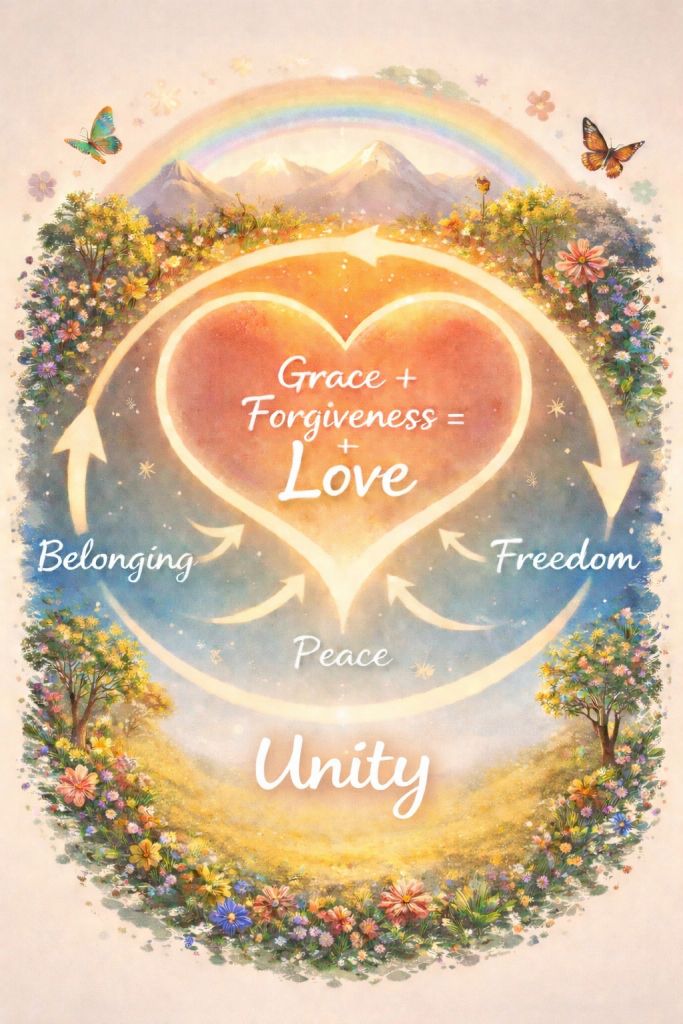
We only experience love when we allow grace and forgiveness to come together.

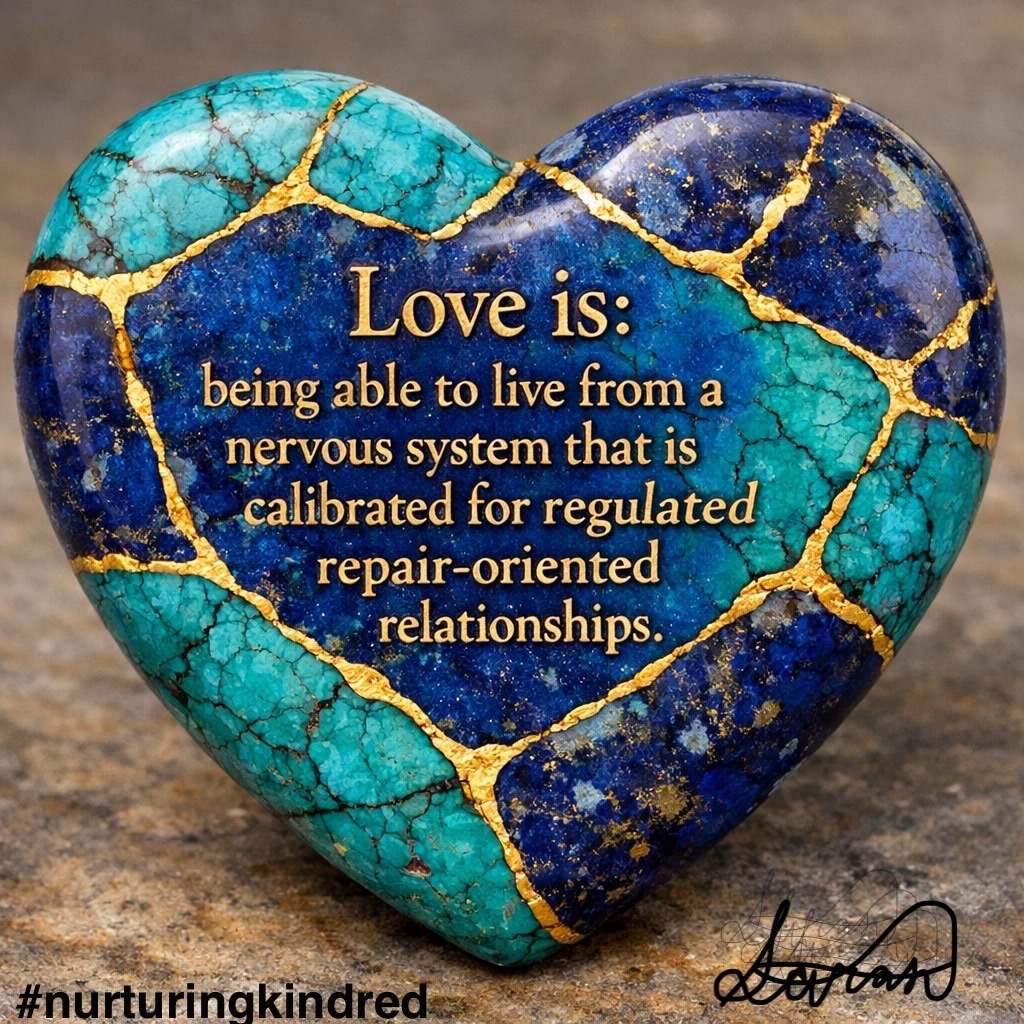
It seems that these two states are made up of similar parts with distinct differences, meant to relate interdependently to create love as a regenerative, creative, expansive, resilient, diverse state.

Grace can stand alone without forgiveness.

And forgiveness can stand alone without grace.

And it seems that the equation that produces love is something like this:

grace + forgiveness = love

It feels like supernatural math.

Like 1 + 1 = 3.

Grace opens the space.

Forgiveness releases what was held.

Grace says we still belong together, and no punishment is needed for that to be true.

Forgiveness says we don’t have to carry the pain or fear of being harmed anymore.

And when those two states meet and are joined together, something new appears.

Love.

Love isn’t only grace.

Love isn’t only forgiveness.

Love carries both of them and becomes more.

It is as if grace and forgiveness recognize and accept each other.

And when they come together, they create something larger than either one alone.

Love.

And love does something else.

It multiplies.

Grace makes space for forgiveness.

Forgiveness welcomes grace.

Together they create love.

And love begins to create a resilient, diverse community of belonging.

Belonging plus love creates peace.

Peace plus love and belonging creates freedom.

Freedom creates patience, kindness, gentleness, self-control, and more.

And suddenly the equation keeps expanding as more states that support resilience emerge.

Love creates a unified community. Love creates unity.

And unity does not erase difference.

Unity protects freedom.

Unity holds everyone inside belonging.

And when I look at that pattern, it starts to look familiar.

It starts to look like the mystery we see in God.

Father.

Son.

Spirit.

Different.

And yet the same.

Three.

And yet one.

Not competing.

Not controlling.

Not excluding.

Just existing in perfect relationship.

And when relationship is whole like that, something beautiful happens.

Love keeps multiplying.

Maybe this is what it means that humans are created in the image of God.

Beings unique and so similar.

Not to control each other.

Not to rank each other.

But to learn how to live inside that same kind of relationship.

Grace making space.

Forgiveness releasing harm.

Love multiplying belonging.

Peace holding it all together.

And because peace sits at the foundation of it all, it has remained very good.

Even when we forget.

Even when we fall back into the old patterns.

Grace is still there.

Forgiveness is still possible.

Love is still multiplying.

So perhaps the most important thing we can do is the simplest thing.

Trust the process.

Grace makes space.

Forgiveness releases what was held.

And when grace and forgiveness meet, love appears.

Grace + forgiveness = love.

And love keeps expanding.

Love creates belonging.

Belonging creates peace.

Peace creates freedom.

And freedom allows something beautiful to happen.

Difference no longer needs to compete or dominate to survive.

Difference becomes part of a resilient, living community.

Maybe this is part of what it means that humanity reflects the image of God, life that is generative, relational, and creative beyond anything we could fully imagine.

Perhaps every new life, every new person, every new expression of humanity is another glimpse of that mystery unfolding.

And maybe the point is not to compare forms of generativity at all.

The point is simply to recognize the wonder of it.

To recognize that life keeps creating new expressions of itself.

That diversity is not a threat to unity. It is part of its beauty.

Comparison is truly the thief of joy, and a waste of good energy.

Appreciating the diversity of all things, and being grateful that everything serves a purpose and has a place in the ecosystem of life, is what really matters.

Value the diversity.
Our ecosystem would not be so wonderfully complex and beautiful without it all.

Love is the Way

Although Jesus’ whole life on Earth was a clear unfolding of God’s way of dialogue, patience, provision, and peace, God-followers have continued to use death, oppression, and supremacy as the way of security.

I recently read a scathing critique of Hegseth. And while I understand the outrage, scapegoating one person will not move us forward effectively.

Hegseth’s position—that violence and domination secure peace—is not new. It is a position deeply embedded in human culture and history.

The question is not simply whether Hegseth is wrong.The question is whether we are willing to look honestly at ourselves and see how we too might lean into a similar pattern, because the reliance on violence as a strategy for security has been endemic throughout human history, from ancient times to modern ones.

And if Jesus shows us God’s character, what does that mean for the violent stories we celebrate?

The Pattern in Scripture

1 Samuel 30 reflects this tension clearly.

David returned home to find his village burned to the ground and the women and children taken captive by the Amalekites. Yet not one person had been killed.

David asked God if he should pursue them and recover the people. God said yes.

But David did not go in peace, with dialogue and gifts, as Jacob did with Esau, and as Abigail did with David.

And it is not that David did not know kindness or mercy.

At other times he showed compassion. On the way to confront the Amalekites he stopped to nurse a dying man back to health. Earlier in his life, when he had the opportunity to kill King Saul, he chose restraint and dialogue instead.

Yet when David reached the Amalekite camp, he spent days slaughtering Amalekites in retribution, as if destroying them would eliminate the problem once and for all.

That remained his strategy even to the end of his life, when he advised his son, who was ascending the throne, to secure his kingdom by eliminating opponents.

This pattern appears again and again: Moses and the slaughter following the golden calf; Joshua and the destruction of Jericho; the punishment of Achan.

God-followers have a long history of ordering and celebrating the killing of thousands and tens of thousands and declaring that this is divine intervention.

The thing is that this is not God’s way. It is human culture. It is a very human strategy for dealing with fear and uncertainty.

And yet God keeps showing us something different.

From Cain to Peter, and Saul who became Paul, we see again and again that slaughter, oppression, and persecution are not the way.

Abigail understood God’s way when she approached David with humility, dialogue, and gifts to avert his vengeful attack against Nabal. Using violence to protect one’s honour is enacting vengeance—so yes she averted David’s vengeful response to Nabal’s disrespect and refusal of reciprocity.

Abigail did not control David. She created the conditions for him to choose differently.

Jacob understood it when he approached Esau with humility, dialogue, and gifts.

Solomon understood it to a large degree as well, though influenced by the traditions of his father and by the culture around him.

The prophets understood it. Hosea. Micah. And others.

They told us that grace, forgiveness, love, justice that cares for others, and peace are the way. And they also sometimes misunderstood God’s heart, and spoke from the perspective of divinely imposed punishment instead of recognizing Israel’s misfortunes as the natural consequences of refusing Divine protection.

And in all our misunderstandings, God patiently stays with us waiting for that time when we will understand His grace and come home for protection, so that He can joyfully celebrate our restoration with zero remonstration.

This is Emanuel. God with us.

Jesus shows us the way. Jesus demonstrated this same truth as God in human form.

His life was a clear unfolding of God’s way of dialogue, patience, provision, and peace.

And yet when he showed us this way, we tortured him, killed him, and betrayed him.

In that moment we even declared that we were willing to carry his blood on our heads and on our children’s heads in order to secure wealth, control, and national security through brutality.

But Jesus showed us that death is not a winning strategy.

Violence does not solve violence. Violence begets violence.

When violence becomes the strategy, victory is shallow and short-lived. We must remain ready to kill again, because someone will always seek to respond with violence in return.

🦋

Evangelical Christianity is not less aggressive than the violent strategies it often condemns.

There are many ways to destroy human beings besides physical death.

If Evangelical Christianity pauses and looks honestly into the mirror of Christ’s love, example, and teaching, we would see the logs of violence protruding from our own eyes.

We preach, teach, and practice supremacy, hierarchy, oppression, and control in parenting, in marriage, in employment, in education, in leadership, and in justice systems.

How?

Not always through overt harm, but through the normalization of power-over instead of mutuality.

In parenting, we call it obedience.

We teach children that compliance is more important than connection, that authority must not be questioned, and that love is expressed through control rather than attunement. The child learns to perform rather than to be known.

In marriage, we call it roles.

We elevate one voice over another, often sanctifying dominance as “headship,” and submission as silence. Mutuality is replaced with hierarchy, and love becomes structured around power instead of partnership.

In employment, we call it professionalism.

We expect people to suppress their humanity to maintain systems of productivity. Worth becomes tied to output, and those with less authority to control are expected to accommodate those with more, often without question.

In education, we call it discipline and excellence.

We reward conformity, compliance, and performance, while marginalizing difference. Curiosity is constrained, and students are shaped to fit systems rather than systems being shaped to support students.

In leadership, we call it authority.

We place leaders above accountability, equating position with righteousness. Questioning becomes rebellion, and protecting the institution becomes more important than protecting people.

In justice systems, we call it order.

We prioritize punishment over restoration, control over healing, and often uphold systems that disproportionately harm the most vulnerable while claiming moral legitimacy.

And underneath all of this is a shared pattern:

We have mistaken the withholding of physical force for peace, while continuing to use emotional, relational, and structural force to dominate, silence, and shape others.

We have called it discipline when we override another’s voice.

We have called it leadership when we refuse mutual accountability.

We have called it protection when we restrict autonomy.

And so we have convinced ourselves that we are not violent, because our violence does not always leave visible marks.

This is how supremacy sustains itself—not always through visible violence, but through everyday structures that normalize inequality and call it good.

We do not become “evil” people.

But we begin to bear the fruits of moving out of alignment with love.

My hope is that we will face that mirror of love. That we will see the log. That we will work with God, individually and together, to remove it.

That we will accept the offer of healing with new eyes, new hearts, and new ideologies that embrace grace, forgiveness, love, and peace.

Because perfect love casts out fear.

And without fear we would not need to hoard massive war chests in defense of freedom.

We could all be prosperous, peaceful, and free.

“For God so loved the world that He gave His only begotten Son, that whoever believes in Him should not perish but have eternal life. For God did not send His Son into the world to condemn the world, but that the world through Him might be saved.”
— John 3:16–17

In the beginning God clothed Adam and Eve and gave them the space they needed to experience the knowledge of good and evil that they chose.

And through the peaceful life of Jesus God crushed the serpent’s idea that shame, blame, and death were necessary to gain knowledge or control. And we know that shame and blame and death were the serpent’s way: because as soon as Adam and Eve chose that experience, they immediately felt shame. They began to cast blame, and then they taught their children that a sacrifice of blood was needed for freedom.

The text does not describe God killing an animal. That is nowhere described in the interaction between them. What it shows is God clothing them and caring for them.

God made them clothes that were better than the leaves that they had chosen. He created clothes for them just as He had created the world—without violence.

God showed them what some prophets showed us too:

Grace.

Forgiveness.

Love.

Justice that cares for others.

Peace.

This is the way.

May we finally begin to lean toward peace.

May we each finally say,

“Let there be peace on Earth, and let it begin with me.”

https://youtu.be/_AMvzan3EKM?si=ipfMC9PhGg7aNuJW

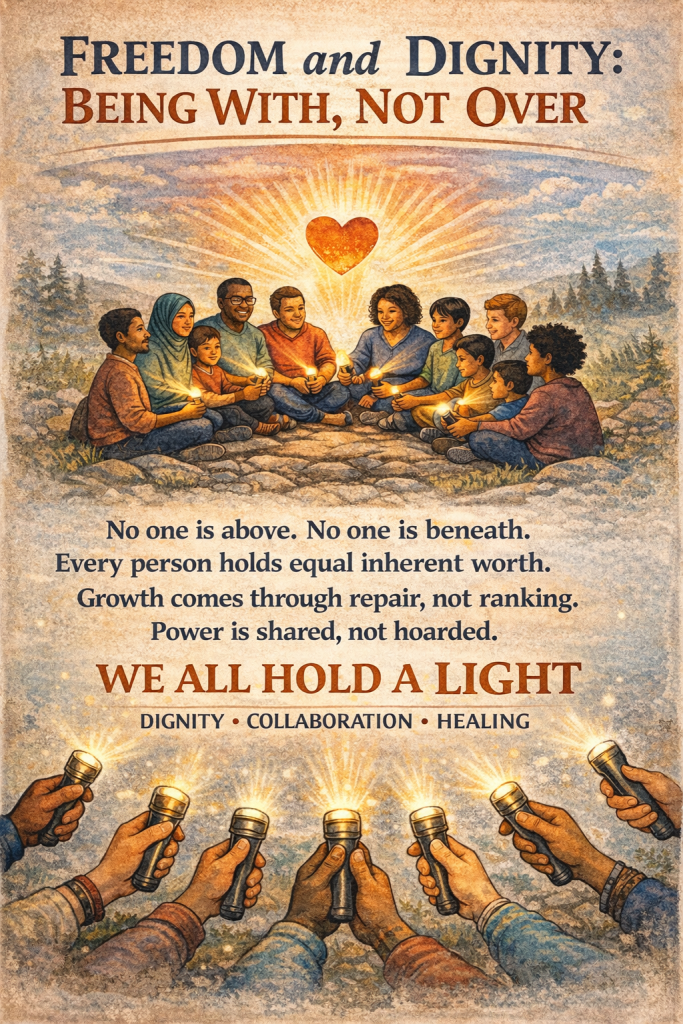
Freedom and Dignity: Being With, Not Over — Rethinking Power in Healing and Community

The realizations I am sharing here came together cohesively after watching the documentary Bearing Witness: The Case of Robert Coley-Donohue, and after a meaningful conversation with a peer who has been working to optimize their mental health through the process of therapy with a clinician.

From the time I was very young, I carried a knowing in my heart and mind that all people need compassion, and that none of us is better than another.

We are all ordinary people with an extraordinary capacity for compassionate growth together.

Because so many of our systems are built on power-over and supremacy, what lived in me often appeared as stubbornness on the outside.

What I understand now is that it was not stubbornness.

It was a refusal to collapse into hierarchical conditioning — conditioning that claimed some people had the right to control others, or to hold dominant positions within relationships.

It was a consistent refusal to agree that worth could be ranked.

A consistent refusal to trade connection for control.

For most of my life, I did not have the language to express this knowing. I struggled to articulate a truth that nevertheless lived resolutely within me.

What I did have was a deep, steady sense that love does not organize itself by dominance — and a shadowy awareness that we were being conditioned into a counterintuitive framework of control. A framework that generates rebellion, dehumanization, and rupture as people struggle to live with freedom, dignity, and abundance.

So I resisted.

Not gracefully.

Not skillfully.

And always faithfully to that early knowing.

Most of the time I refused to take sides. I could almost always see the why—and I wrestled hard not to dive into hate where harm was being done. That inner battle sometimes looked like defiance, or dominance, or disruption.

And now I can see that what once looked like defiance was devotion — devotion to dignity, mine and everyone else’s, and devotion to freedom, abundance, and accountability.

As so often happens, this clarity arrived through relationship — the sum of lived experience finally filtering through the lens of the pure love of the higher power that sustains us all.

So I will offer a specific example and invite us to apply this lens to every relationship within our global framework. I’ll begin with the relationship between therapists and the people with whom they work.

Therapists are people with professional-level knowledge of current best-practice tools and approaches that support trauma processing and integration, helping people make sense of their experiences and move forward with meaning.

Remembering that therapists are people — with the same struggles as all people — releases them from the pressure to have every answer, to never get triggered, to always say the exact right thing, or to live above the messiness the rest of us inhabit.

Therapists learn frameworks, patterns, nervous-system science, attachment theory, communication tools — all of that can be taught.

But being regulated while your own fear is activated…

staying present when something touches your own wound…

choosing humility instead of defensiveness…that part is lived, not memorized.

Therapists are people doing highly skilled work — not enlightened beings floating above the human condition. Remembering this creates peace, compassion, progress, and emotional safety within the therapeutic relationship.

Because therapy was never meant to be “The Expert Fixes Me.”

It is more like:

“Two humans sit together looking for a treasure, and one has specialized training in how to hold the flashlight.”

The therapist knows where to point the light — and still has their own dark corners at home. They are spiritual beings having a human experience, as we all are. Ordinary people.

And the other truth is this: we all hold a flashlight. Not the same one — but a flashlight no one else can hold in quite the way we do.

Returning to therapists:

Seeing therapists as people

🦋reduces pedestal pressure

🦋allows for repair when mistakes happen

🦋makes therapy more collaborative

🦋keeps power dynamics healthy

🦋reminds us that growth is a shared process, not a one-sided performance

This does not lower the standard of professionalism.

It grounds professionalism in reality — and gives us all the freedom to be ordinary people with an extraordinary capacity for compassionate growth together.

To repeat this for emphasis — because this clarity is deeply dignifying:

When I say therapists are people with professional-level knowledge, I mean exactly that.

They carry tools.

They carry training.

They carry responsibility.

And they are still human beings walking through their own healing, their own triggers, their own growth edges — just like everyone else.

Remembering this does not diminish the profession.

It restores the humanity inside it.

It releases therapists from the impossible burden of being perfect, all-knowing, or emotionally invulnerable.

And it releases clients from the belief that healing comes from being fixed by someone “above” them.

This echoes the wisdom of Yeshua M’shīkhā — also called Jesus Christ — who warned against confusing good teachings with flawless teachers. Not don’t learn from them, but don’t put the pressure of idealism on them. Stay awake. Stay grounded. Stay relational. Stay compassionate. Our helpers lead us to dignity; they are not the way.

Therapy, like faith, was never meant to be a hierarchy.

It was not meant to be education through dominance. It was meant to be a relationship.

Two humans sitting together.

One trained to help hold their flashlight.

Both still learning how to live in the light.

And this — this levelling of false pedestals — is part of a much older seed in me:

Compassion over comparison. 

Collaboration over control.

Shared humanity over hierarchical worth.

That seed is what makes real conflict resolution possible. Because when no one is trying to be above, we can finally be with. We can listen without defensiveness. Repair without humiliation. Grow without domination.

That is how communities of true belonging are built — not by perfect leaders, but by ordinary people, brave enough to stay human together, supported by regulations and processes that protect health, freedom, dignity, abundance, and accountability from the beginning to the end of our lives.

We do all this holding fast to the abiding truth: every child matters, and every part of the world we inhabit matters too.

Now apply this idea to every person in leadership in every position in our lives, parents; teachers; spiritual advisors; doctors; builders; managers; stylists etc. etc. etc. —including ourselves as the ultimate leader of our own choices.

How does this sit in your nervous system? Does it feel like we might finally able to move towards building and sustaining a thriving home together?

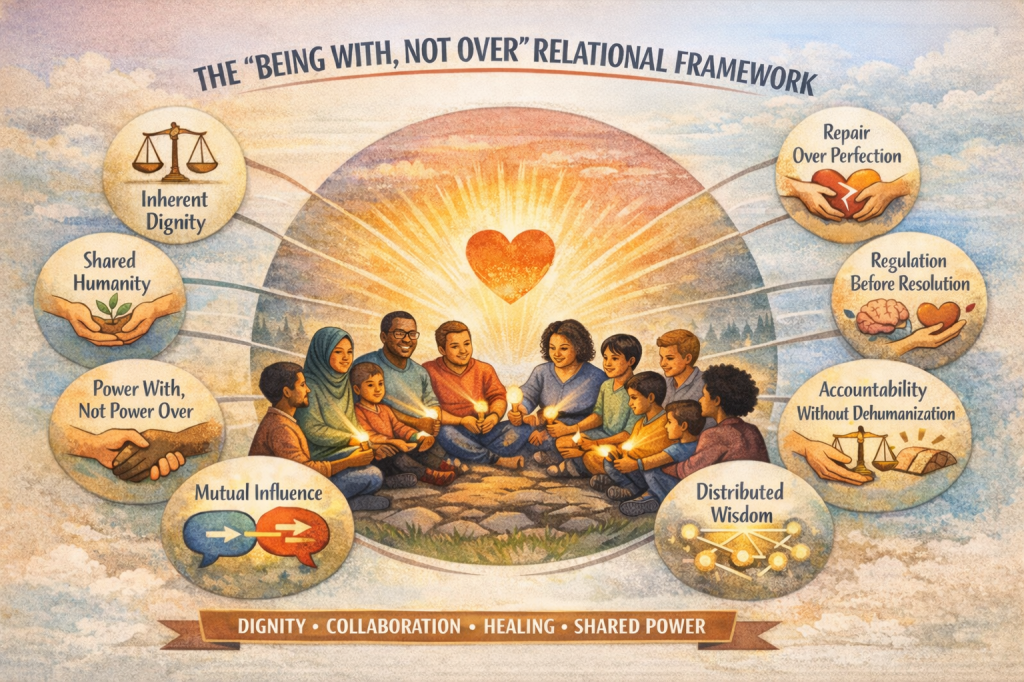
The “Being With, Not Over” Relational Framework

Eight Pillars

1. Inherent Dignity

Every person holds equal human worth, regardless of role, age, status, education, or capacity.

In practice:

  • No shaming as a behaviour-control tool
  • No using expertise to diminish someone’s voice
  • No ranking whose feelings “matter more”

Dignity is not earned. It is recognized.

2. Shared Humanity

Expertise does not erase humanness. Leadership does not remove vulnerability.

In practice:

  • Therapists can acknowledge mistakes
  • Parents can repair after misattunement
  • Leaders can say “I don’t know”
  • We allow imperfection without collapsing accountability

This replaces pedestal dynamics with relational presence.

3. Power With, Not Power Over

Power is used to support safety, growth, and agency — not dominance or control.

In practice:

  • Clear boundaries without humiliation
  • Structure without dehumanization
  • Authority that protects, not suppresses

Power becomes a stabilizing force, not a threat.

4. Mutual Influence

Even in asymmetrical roles (therapist/client, parent/child, teacher/student), both people affect the relationship.

In practice:

  • Feedback is welcomed
  • Repair is collaborative
  • Listening flows both directions (within appropriate boundaries)

No one is treated as an object to be managed.

5. Repair Over Perfection

Relationships grow through rupture and repair, not flawless performance.

In practice:

  • We name harm without shame
  • We apologize without defensiveness
  • We allow learning instead of exile

Repair builds trust more deeply than pretending nothing happened.

6. Regulation Before Resolution

Safety and nervous system settling come before problem-solving.

In practice:

  • Slow the conversation when emotions escalate
  • Co-regulate before correcting
  • Recognize survival responses as signals, not moral failures

Connection restores capacity for collaboration.

7. Accountability Without Dehumanization

People are responsible for their impact — and still worthy of dignity.

In practice:

  • Behaviour is addressed without attacking identity
  • Consequences are protective, not punitive
  • Growth is expected, not demanded through fear

Accountability becomes a path back into belonging, not a door out.


8. Distributed Wisdom

No one holds all the light. Every person carries perspective, insight, and lived knowledge.

In practice:

  • Professionals respect lived experience
  • Leaders consult those affected
  • Families include children’s voices appropriately amplified

We all hold a flashlight.

What This Framework Creates

When these principles guide relationships, we get:

  • Less defensiveness
  • More repair
  • Safer conflict
  • Stronger trust
  • Real belonging
  • Sustainable collaboration

This is how homes, therapy rooms, classrooms, and communities become places where people can grow with dignity, without fear of being ranked, shamed, or dominated.

Freedom and Dignity: Being With, Not Over

A Relational Manifesto

We believe every person holds inherent dignity.

No role, title, age, education, or status makes one human being more valuable than another.

We reject systems built on domination, ranking, and control.

We choose relationships built on compassion, presence, accountability, and shared humanity.

We believe expertise is real — and humanness remains.

Teachers, therapists, parents, leaders — al helpers carry knowledge and responsibility,

and they are still people — learning, healing, and growing alongside everyone else.

We refuse pedestals.

We refuse dehumanization.

We refuse the lie that power must mean “over.”

We choose power with —

power that protects without humiliating,

guides without controlling,

and leads without erasing the voices of others.

We believe growth comes through repair, not perfection.

Through listening, not silencing.

Through regulation, not reactivity.

Through accountability that restores dignity rather than removing it.

We believe every person carries light.

Not the same light —

but a light no one else can hold in quite the same way.

When we stop trying to be above one another,

we can finally be with one another.

And from that place, conflict becomes conversation.

Difference becomes learning.

Responsibility becomes shared.

Belonging becomes possible.

This is how homes heal.

This is how communities grow.

This is how leadership becomes trustworthy.

Not through dominance —

but through dignity.

Not through control —

but through connection.

We are ordinary people

with an extraordinary capacity

to support dignity together.

The Shit is Real AND We are Good. Period

AND; not but, AND.

So how to AND here? This is very hella real. How can one possibly take no shit when often the turds of constipated emotional backup or the flood of crap caused by irritable brain syndrome comes gushing at you with turbo speed?

Let me sell us a masterclass in creating a consistently perfect shit to gold shield.

Psalm 121 NLT
I look up toward the hills.
From where does my help come?
2 My help comes from the Lord,
the Creator of heaven and earth.
3 May they not allow your foot to slip.
May your Protector not sleep.
4 Look! Israel’s Protector
does not sleep or slumber.
5 The Lord is your protector;
the Lord is the shade at your right hand.
6 The sun will not harm you by day,
or the moon by night.
7 The Lord will protect you from all harm;
They will protect your life.
8 The Lord will protect you in all you do,
now and forevermore.

⬆️ That up there. Best teacher, best coach. God will protect our right hand AND the rest of us WHILE we learn how to SUIT up in the WHOLE armour of God. Legit.

Ephesians 6:13-18
13 Therefore put on the full armor of God, so that when the day of evil comes, you may be able to stand your ground, and after you have done everything, to stand. 14 Stand firm then, with the belt of truth buckled around your waist, with the breastplate of righteousness in place, 15 and with your feet fitted with the readiness that comes from the gospel of peace. 16 In addition to all this, take up the shield of faith, with which you can extinguish all the flaming arrows of the evil one. 17 Take the helmet of salvation and the sword of the Spirit, which is the word of God.

May we learn to invoke God’s blessing of loving-kindness with such consistent speed that shit turns to pure harmless liquid gold as soon as a shitter even thinks about us.

Yesterday the POTUS posted publicly in the spirit of the reality of the history that surrounds North American Thanksgiving celebrations in both countries.

And my heart and the hearts of all of us in innocence remains in the elevation of peace and healing. This prayer stays in our hearts – consciously or unconsciously. May we all become actively conscious of it.

A Prayer for All Leaders

For world leaders, spiritual leaders, and healing leaders: in the name of Yeshua M’shikha

Baba Ndiri – our Father in heaven, in the name of Yeshua M’shikha,
I lift every leader on this earth before You.

Those who mold nations, those who guide churches and temples, those who seek to inspire in schools, hospitals, healing organizations, and communities in their care.

You alone see the truth behind every public mask.
You see the wounds that created defensiveness, the fears that hardened their instincts,
the longing they still carry
to be safe, to be worthy,
to be seen,
to be loved.

Baba, with lovingkindness we affirm the childlike innocence that You placed in every soul and we are thankful that it can rise again within us.

May we remember that we need more than naïveté that ignores wisdom,
We welcome the purity that recognizes truth without manipulation, that sees humanity before politics, that responds with curiosity instead of pride, and gentleness instead of force.

Let peace, not dominance and superiority
become the operating system of every leader’s heart.

We thank you for sifting the tares from the wheat in our leaders’ hearts.

Sift away fear so that courage remains.
Sift away ego and retain humility.
Where power has been misused, we invoke the power of repentance and repair.
Where trauma has shaped leadership, plant integration, healing, and nervous systems at rest.

May the leaders of nations remember the weight and worth of every human life.

May the leaders of religious communities
remember that no doctrine is ever more sacred than the people who stand before them.

May the leaders of healing organizations
remember the tenderness towards people that makes their calling holy.

Baba, teach us all to lead as Yeshua led,
not through domination, but with presence and peace, with truth that frees, and with love that does not fear complexity.

Let their decisions be guided by compassion, by the wellbeing of those
they have been entrusted to serve.

And may Your Spirit whisper
into the quiet places of all of our hearts, reminding us that strength is not control,
but alignment with Love.

That is power.

May innocence rise above agenda.
May peace rise above pride.
May wisdom rise above noise.
And may we all be transformed into living instruments of restoration, liberation, and healing peace.

May we remember the powerful intellect of our inner child.

May we align with Your kingdom of Love on Earth, as it is in heaven.

Forever and ever. Asé and amen.

We’re good. The shit is real, and we have the ability to turn it into gold together in this one-diversely-full world.

Peace to you.

With love and solidarity from Saran, the Queen of Joy.

Where Peace Lives Freely, Hope Grows Without Fear

By Saran A.N. Lewis

Freedom: powerful, joyful, unashamed.

Two men stand together in a formal room marked by symbols of national leadership. One is seated at a wooden desk, looking upward with a wide, genuine smile that softens the whole atmosphere. The other stands beside him with a calm, steady presence, shoulders relaxed, expression gentle, posture grounded and at ease.

The moment between them feels unexpectedly peaceful.
Not staged.
Not guarded.
Just human.

There is warmth in the eyes of the man standing.
There is openness in the smile of the man seated.
And between them, there is a sense of dignity, quiet respect, and shared possibility.

It is a picture of two people meeting each other without the armor that usually surrounds power. A moment where defenses seem lowered. A moment where humanity feels visible again.

This image reminds us that peace is possible even in places shaped by tension.
That connection can appear in unexpected ways.
That leadership, at its best, carries a pulse of humility and hope.

These are powerfully beautiful moments where people choose presence over posturing, warmth over walls, softness over spectacle.

This moment deserves to be seen for what it is: a glimpse of what could be when peace is allowed to breathe.

Why did so many of us make fun of it?

Why is the spirit of division and bullying so prevalent among us?

What are we afraid of?

We took unfamiliar peace and turned it into familiar chaos.

Why do we feel that we must pick sides? Why can’t we just elevate and appreciate peace? This was such a beautiful and powerful moment.

Being in industry Trump had genuine concerns about his nation’s profit. He might have been uniquely positioned to understand inequity in progress with awareness of other nations’ attempts to undermine US economic stability so that other countries could emerge as superpowers, in a world where being powerful meant being colonized.

Wanting to avert that is not wrong. What shapes the methodology is important.

Being shaped by a life lived across communities and systems, Mamdani developed a different but equally compelling concern, one rooted in understanding how policy and progress affect those without automatic access. His lived experience seems to have taught him what inequity looks like from the ground up, not as theory but as reality. From that vantage point, his ambition may be guided by a desire to widen opportunity, reshape systems, and bring fairness into spaces that once overlooked people like him. This kind of perspective can fuel a drive not only to succeed personally, but to ensure that others coming after him meet fewer barriers and more open pathways.

Both men aspire to address legitimate concerns, can we pause to understand what shapes their methodology so that we can move forward with informed compassion and wisdom together?

Can we seek accountability which leads to global progress, understanding that “words fitly spoken are like apples of gold in settings of silver”.

A Prayer for All Leaders

For world leaders, spiritual leaders, and healing leaders: in the name of Yeshua M’shikha

Baba Ndiri – our Father in heaven, in the name of Yeshua M’shikha,
I lift every leader on this earth before You.

Those who mold nations, those who guide churches and temples, those who seek to inspire in schools, hospitals, healing organizations, and communities in their care.

You alone see the truth behind every public mask.
You see the wounds that created defensiveness, the fears that hardened their instincts,
the longing they still carry
to be safe, to be worthy,
to be seen,
to be loved.

Baba, with lovingkindness we affirm the childlike innocence that You placed in every soul and we are thankful that it can rise again within us.

May we remember that we need more than naïveté that ignores wisdom,
We welcome the purity that recognizes truth without manipulation, that sees humanity before politics, that responds with curiosity instead of pride, and gentleness instead of force.

Let peace, not dominance and superiority
become the operating system of every leader’s heart.

We thank you for sifting the tares from the wheat in our leaders’ hearts.

Sift away fear so that courage remains.
Sift away ego and retain humility.
Where power has been misused, we invoke the power of repentance and repair.
Where trauma has shaped leadership, plant integration, healing, and nervous systems at rest.

May the leaders of nations remember the weight and worth of every human life.

May the leaders of religious communities
remember that no doctrine is ever more sacred than the people who stand before them.

May the leaders of healing organizations
remember the tenderness towards people that makes their calling holy.

Baba, teach us all to lead as Yeshua led,
not through domination, but with presence and peace, with truth that frees, and with love that does not fear complexity.

Let their decisions be guided by compassion, by the wellbeing of those
they have been entrusted to serve.

And may Your Spirit whisper
into the quiet places of all of our hearts, reminding us that strength is not control,
but alignment with Love.

That is power.

May innocence rise above agenda.
May peace rise above pride.
May wisdom rise above noise.
And may we all be transformed into living instruments of restoration, liberation, and healing peace.

May we remember the powerful intellect of our inner child.

May we align with Your kingdom of Love on Earth, as it is in heaven.

Forever and ever. Asé and amen.